Engineers searching for glass-to-metal sealed RF EMI filters are often comparing hermetic feedthrough filters with conventional epoxy-sealed components for aerospace, defense, radar, and satellite applications.
In most electronic enclosures, resin-sealed feedthrough filters adequately suppress conducted interference at panel entry points. For the majority of industrial, commercial, and communications applications, resin provides sufficient environmental protection and the component performs as specified over its service life.
However, mission-critical hardware including avionics, radar, satellite electronics, defense communication gear and specific medical devices operates under extreme operating conditions that exceed the protective limits of epoxy resin encapsulation; high-altitude exposure, repeated thermal cycling, severe mechanical shock, and adjacent contamination-sensitive components create strict reliability demands that can only be consistently satisfied by hermetic glass-to-metal sealed feedthrough designs.
Through this guide, LCA engineers elaborate on this core distinction and provide a practical specification and procurement framework to help design and sourcing teams select high-reliability feedthrough components more efficiently. Based on LCA’s experience supporting aerospace, defense, medical imaging, and high-frequency RF projects, engineers typically evaluate hermetic sealing alongside insertion loss, package size, qualification requirements, and long-term reliability during component selection.
What Glass-to-Mmetal Sealing Delivers That Other Construction Types Cannot
The Hermetic Seal: Definition and What It Prevents
A hermetic seal is a seal whose leak rate is low enough to prevent meaningful gas or moisture exchange between the interior and exterior of the sealed package over the component’s service life. In a hermetically sealed miniature RF EMI filter, the glass sealing material bonds the inner conductor to the outer metallic body, creating a sealed feedthrough that prevents moisture ingress from the external environment and prevents outgassing from any internal materials.
The qualification criterion for hermeticity is a measured leak rate — typically verified by helium fine leak testing per MIL-STD-202 Method 112 or an equivalent procedure. The acceptable leak rate is application-specific and must be stated as part of the component specification. Confirmation that the manufacturer performs and documents hermetic leak testing as part of the production process is a necessary step in supplier qualification for mission-critical programs.
Resin Sealing vs. Glass-to-Metal Sealing
Resin-sealed construction fills the filter body cavity with an encapsulant, providing protection against dust, humidity, and moderate chemical exposure. For most industrial and commercial applications, this is adequate. For mission-critical platforms, two limitations of resin become relevant:
Outgassing: Resin materials release volatile compounds over time, particularly under elevated temperature or reduced atmospheric pressure. In sealed electronics enclosures containing RF components or optical elements, outgassing can deposit contamination on surfaces, alter dielectric properties, or degrade adjacent components. Glass-to-metal sealed construction eliminates internal material outgassing as a failure mechanism.
Long-term moisture integrity: Over extended service periods under thermal cycling, the interface between resin and metal can develop micro-gaps through which moisture slowly permeates. For systems designed for 20-year or longer service lives — common in aerospace and defense platforms — hermetic glass-to-metal sealing provides more reliable long-term environmental integrity than resin.
Altitude and Atmospheric Pressure:At altitude, reduced atmospheric pressure affects the performance of sealed components differently than at sea level. Resin-sealed filters that perform acceptably at ground level may behave differently when the pressure differential across the seal increases at high altitude. This is a specific concern for avionics and satellite electronics, where glass-to-metal hermetic construction is the accepted solution regardless of whether moisture exposure is the primary concern.
Comparison Table
| Characteristic | Glass-to-metal sealed | Resin-sealed |
| Hermetic integrity | Yes — verifiable by leak test | No — permeable over time |
| Outgassing | Negligible | Possible under T/vacuum |
| Altitude suitability | Yes | Limited |
| High-frequency performance | High (low ESL, high SRF for miniature package) | Similar at equivalent capacitance |
| Assembly compatibility | Gold bonding or solder (specify plating) | Solder |
| Qualification documentation | Available for MIL-PRF-15733 relevant parts | Standard datasheet |
| Cost relative to standard | Higher | Moderate |
| Service life suitability | Long (decades for platform programs) | Moderate (industrial product life) |
What Is a Miniature RF EMI Filter?
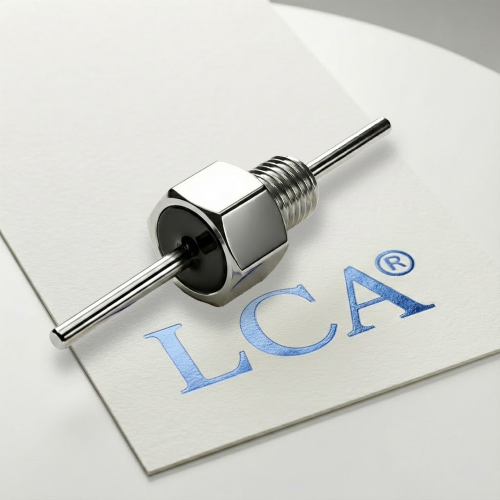
A miniature RF EMI filter is a compact feedthrough-style capacitive component designed to suppress conducted interference on RF signal lines, DC bias lines, or power penetrations through shielded enclosures. The “miniature” designation refers to a small physical package — body dimensions typically measured in millimeters — that integrates the filtering function at the point where a conductor crosses an enclosure boundary.
How the Feedthrough Geometry Provides Low-Inductance Noise Shunting
The conductor passes through the filter body. High-frequency noise on the conductor is coupled capacitively to the outer electrode, which bonds directly to the chassis ground. This geometry keeps the noise shunt path short and minimizes the parasitic inductance in that path — which is what allows the filter to remain effective at RF frequencies where larger components with longer ground paths would have already transitioned to inductive behavior.
For miniature packages specifically, the smaller physical size means even lower shunt-path inductance and a higher self-resonant frequency (SRF) compared to standard-size tubular or solder-in filters of the same capacitance value. This is the primary reason miniature RF EMI filters are used in RF module, hybrid circuit, and microwave subsystem applications where larger components would have insufficient high-frequency performance.
Filter Topology
Most miniature RF EMI filters use a C-type (single shunt capacitor) topology, which provides common-mode noise suppression and RF bypass over a defined frequency range. Above the SRF of the specific component, the shunt impedance rises and attenuation decreases. Engineers must verify from the product’s insertion loss vs. frequency curve — not from the nominal capacitance value — that the SRF is above the highest frequency of concern in the application.
Insertion Loss: What the Frequency Curve Shows and What It Does Not
Published insertion loss curves for miniature RF EMI filters are measured in standardized test fixtures. In hybrid circuit and microwave module applications, actual in-circuit performance depends on the proximity and quality of the ground connection on the substrate, which can differ from the standardized test condition. Published values are useful for comparative component evaluation and for confirming the SRF is in the right range; they are not a guarantee of in-circuit performance. Verify in the actual circuit or a representative test fixture before finalizing the design.
For LCA’s HA series miniature RF filters, published catalog values for 10 pF parts show 5 dB insertion loss at 1 GHz and 12 dB at 10 GHz, measured under standardized conditions. These are catalog reference values and should not be treated as guaranteed in-circuit specifications.
Where Glass-Sealed Miniature RF EMI Filters Are Used
| Application | Why hermetic miniature RF filter | Key environmental driver |
| Avionics signal conditioning | Altitude, thermal cycling, outgassing risk in sealed enclosures | Reduced atmospheric pressure; contamination control |
| Radar and EW subsystems | Dense RF environment, long service life, platform qualification | Vibration, thermal cycling, MIL-STD-461 compliance |
| Satellite and space electronics | No moisture servicing possible; outgassing critical | Vacuum, radiation, thermal extremes |
| Defense RF communications | Long-term hermeticity, MIL qualification required | Field environment, service life, QPL requirements |
| Medical imaging RF systems | Stable high-frequency behavior, regulatory traceability | Moisture, cleaning agents, long service |
| Microwave modules and hybrid circuits | Compact size, gold bonding, low parasitic inductance | Package integration, wire bonding process |
Procurement Guide for Purchasing Engineers
Key Specification Parameters
Procurement teams sourcing glass-sealed miniature RF EMI filters for mission-critical programs frequently receive requests with only voltage, capacitance, and package size specified. The following parameters are all required for a complete specification.
Capacitance value and tolerance: Determines the filter’s noise shunt frequency range. Tolerance class affects the consistency of the cutoff frequency across production lots.
Voltage rating: Must match the maximum operating voltage, separately for DC and AC where both are present. For RF signal line applications, the voltage rating interacts with the RF power handling requirement.
Insertion loss requirement: State as minimum attenuation in dB at defined frequencies across the relevant range — not as a topology selection. Confirm the SRF is above the highest frequency of concern from the product’s insertion loss curve.
Package dimensions: Body diameter, body length, lead or termination diameter, and mounting configuration. For hybrid circuit integration, confirm substrate compatibility and bonding pad dimensions.
Plating: Gold plating is required for wire bonding assembly processes in hybrid circuits; confirm bondability requirements with the circuit assembly team before specifying. Silver or nickel plating is appropriate for solder assembly. The choice must be driven by the assembly process, not defaulted to the most common option.
Operating temperature range and thermal cycling: State the minimum and maximum operating temperatures and the number of thermal cycles expected over the component’s service life. These affect both dielectric formulation selection and seal integrity requirements.
Hermeticity requirement: State the required leak rate and the test method. Do not assume a standard value — confirm the requirement with the platform’s environmental qualification plan and communicate it explicitly to the component supplier.
Qualification level: Specify whether a standard catalog part, a screened part, or a part qualified to MIL-PRF-15733 or equivalent is required. This determines the documentation package available and the supplier qualification criteria.
Conclusion
Glass-to-metal sealed miniature RF EMI filters are the preferred solution for aerospace, defense, satellite, medical, and other mission-critical applications where hermetic sealing, long-term reliability, and stable RF performance are essential. Compared with conventional resin-sealed designs, hermetic feedthrough filters provide superior resistance to moisture ingress, outgassing, thermal cycling, and pressure variations.
Selecting the right miniature RF EMI filter requires more than matching capacitance and voltage ratings. Engineers should also evaluate insertion loss, self-resonant frequency (SRF), hermetic leak rate, qualification standards, package dimensions, and plating requirements to ensure reliable long-term performance. Working with an experienced manufacturer early in the design process helps reduce qualification risks and simplifies component selection for demanding RF and EMI applications.
Frequently Asked Questions
Q: What is the practical difference between glass-to-metal sealed and resin-sealed miniature RF EMI filters? The hermetic glass-to-metal seal prevents moisture ingress and eliminates outgassing from internal materials. Resin sealing provides environmental protection adequate for most industrial and commercial applications but does not provide demonstrable hermetic integrity. For applications requiring altitude qualification, contamination-sensitive environments, or long-term moisture exclusion over platform service life, glass-to-metal sealing is the appropriate construction. Resin sealing is not a deficient alternative — it is the correct choice for its intended application range.
Q: Are LCA’s miniature RF EMI filters (HA series) suitable for gold wire bonding? The HA series is available with gold plating. For wire bonding applications, the bonding process parameters must be compatible with the specific gold layer on the part. Confirm bondability requirements — wire diameter, bonding force, temperature, and ultrasonic energy — with LCA’s engineering team before specifying these parts for hybrid circuit assembly.
Q: What insertion loss can I expect at 1 GHz and 10 GHz? Published catalog values for LCA’s HA series 10 pF parts show 5 dB at 1 GHz and 12 dB at 10 GHz in standardized test fixtures. In-circuit performance depends on the ground bond quality and substrate geometry at the installation point and may differ from these values. Always verify in the actual circuit or a representative fixture before design release.
Q: What documentation can LCA provide for the HB hermetically sealed filter series? LCA can provide test reports, material certifications, and lot traceability records for the HB family. The specific documentation scope depends on program requirements and must be discussed with LCA’s engineering team before production orders are placed. The documentation scope should be established as part of the component selection process, not identified after production quantities have been ordered.
Need Help with Glass-to-Metal Sealed Miniature RF EMI Filters for Your Mission-Critical System?
Every aerospace and defense application is different — and so is every reliability challenge.
LCA’s engineering team can help you understand hermetic sealing, RF performance, and qualification requirements — and recommend the right glass-to-metal sealed miniature RF EMI filter for your specific needs.
Contact LCA today for one-to-one technical support and customized EMI suppression recommendations.
Technical parameters cited in this article, including insertion loss values for LCA’s HA series, are drawn from published LCA catalog documentation and are specific to the part numbers indicated. All specifications must be verified against current datasheets for the exact part number in use. Hermeticity requirements, qualification documentation scope, and long-term availability commitments are program-specific and must be confirmed directly with LCA’s engineering and sales teams.