Introduction
Quick Answer: ISO Metric Threads are the world’s most widely used screw thread system.
ISO Metric Threads are the world’s most widely used screw thread system. Unlike Unified threads, which are based on inch dimensions, ISO Metric Threads use millimeters to define thread diameter and pitch. Their standardized dimensions, thread profile, and designation system allow components manufactured around the world to remain interchangeable.
Today, ISO Metric Threads are used in nearly every industry, including industrial machinery, automotive manufacturing, electronics, telecommunications, robotics, medical devices, renewable energy systems, and consumer products.
For manufacturers serving global markets, understanding ISO Metric Threads is essential for selecting compatible fasteners, threaded components, and mounting interfaces.
Quick Definition
ISO Metric Threads are standardized screw threads that use metric dimensions (millimeters) for thread diameter and pitch. They are governed primarily by ISO standards and are identified using the “M” designation, such as M6 × 1 or M12 × 1.75.
What Are ISO Metric Threads?
ISO Metric Threads define the geometry, dimensions, tolerances, and designation of metric screw threads used throughout the world.
Unlike Unified threads that specify pitch using Threads Per Inch (TPI), ISO Metric Threads specify pitch directly in millimeters, representing the distance between adjacent thread crests.
For example:
- M6 × 1
- M8 × 1.25
- M10 × 1.5
- M12 × 1.75
The “M” indicates a metric thread, the first number represents the nominal diameter in millimeters, and the second number indicates the thread pitch.
Because of their international adoption, ISO Metric Threads have become the default thread system in most countries outside North America.
History & Development
Before international metric standardization, different countries used a variety of incompatible metric thread forms.
To improve global interchangeability, the International Organization for Standardization (ISO) established the ISO Metric Thread system. Today, standards such as ISO 68-1, ISO 261, ISO 724, and ISO 965 define the thread profile, preferred diameter and pitch combinations, basic dimensions, and tolerance classes.
This unified system enables manufacturers worldwide to design and produce compatible threaded components.
Understanding Metric Thread Designations
A standard metric thread designation follows this format:
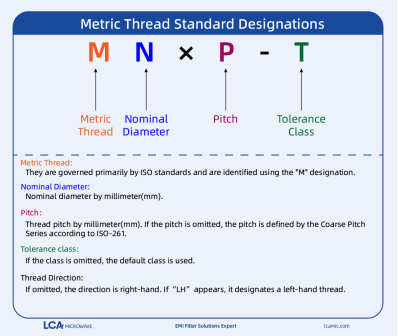
M N × P – T
M Nominal Diameter × Pitch – Tolerance Class
M (Metric Thread):
They are governed primarily by ISO standards and are identified using the “M” designation.
Nominal Diameter:
Nominal diameter by millimeter(mm).
Pitch:
Thread pitch by millimeter(mm). If the pitch is omitted, the pitch is defined by the Coarse Pitch Series according to lSO-261.
Tolerance class:
If the class is omitted, the default class is used.
Thread Direction:
If omitted, the direction is right-hand. If“LH” appears, it designates a left-hand thread.
Example:
M12 × 1.75 – 6g
| Element | Description |
| M | Metric Thread |
| 12 | Nominal Diameter (mm) |
| 1.75 | Thread Pitch (mm) |
| 6g | External Thread Tolerance |
Internal threads typically use 6H, while external threads commonly use 6g.
If the pitch is omitted (e.g., M8), it normally indicates the standard coarse pitch for that diameter.
Metric Coarse vs Fine Threads
ISO Metric Threads are commonly available in coarse-pitch and fine-pitch versions.
For a given nominal diameter, a coarse thread has a larger pitch and fewer threads over the same length. A fine thread has a smaller pitch and more threads over the same length.
Unlike the Unified thread system, ISO Metric Threads do not normally use separate series codes such as UNC or UNF. Instead, the thread pitch is identified directly in the thread designation.
For example:
- M10normally indicates the standard coarse-pitch M10 thread, with a pitch of 5 mm.
- M10 × 1.25indicates an M10 fine-pitch thread.
- M10 × 1.0indicates a finer M10 thread pitch.
The exact available pitch combinations depend on the nominal diameter and the applicable ISO standard.
Metric Coarse Threads
Metric coarse threads are the standard general-purpose thread series for most ISO Metric fasteners.
When the pitch is omitted from a metric thread designation, the standard coarse pitch is generally assumed.
For example:
- M6 = M6 × 1.0
- M8 = M8 × 1.25
- M10 = M10 × 1.5
- M12 = M12 × 1.75
Metric coarse threads are commonly selected because they provide:
- Fast and convenient assembly
- Good resistance to minor thread damage
- Better tolerance of dirt and contamination
- Broad availability of standard fasteners and tooling
- Suitable performance in general industrial applications
Typical applications include industrial machinery, equipment enclosures, structural assemblies, automation systems, and general-purpose threaded components.
Metric Fine Threads
Metric fine threads use a smaller pitch than the standard coarse thread for the same nominal diameter.
Because the pitch is smaller, more threads engage over the same axial length. Fine threads may be selected when an application requires:
- More precise axial adjustment
- Increased thread engagement within a limited length
- Improved resistance to loosening under certain operating conditions
- Reduced radial thread depth
- Compatibility with an existing fine-thread component or industry specification
Metric fine threads are commonly used in automotive systems, aerospace components, hydraulic equipment, precision instruments, thin-wall parts, and specialized mechanical assemblies.
Unlike standard coarse threads, the pitch should be explicitly included in the designation.
For example:
- M10 × 1.25
- M12 × 1.5
- M16 × 1.5
Metric Coarse vs Metric Fine
| Feature | Metric Coarse | Metric Fine |
| Pitch | Larger | Smaller |
| Threads per unit length | Fewer | More |
| Designation | Pitch may be omitted | Pitch should be specified |
| Assembly | Faster | More turns required |
| Damage tolerance | Generally better | More sensitive to damage |
| General-purpose use | Excellent | Less common |
| Precision adjustment | Good | Better |
| Thin-wall applications | May be less suitable | May provide advantages |
| Standard fastener availability | Very broad | More limited |
How to Choose Between Metric Coarse and Fine Threads
Choose a Metric Coarse Thread when:
- General-purpose fastening is required.
- Fast assembly is important.
- Standard fasteners and tooling are preferred.
- The application may be exposed to dirt or minor thread damage.
- No fine-pitch requirement is specified.
Choose a Metric Fine Thread when:
- The engineering drawing specifies a fine pitch.
- More precise adjustment is required.
- The component has limited thread engagement length.
- A thinner thread profile is beneficial for the design.
- Compatibility with an existing fine-thread component is required.
The final selection should always consider material strength, thread engagement length, wall thickness, preload requirements, vibration conditions, and the applicable engineering standard.
Advantages of ISO Metric Threads
ISO Metric Threads provide numerous advantages:
- Global standardization.
- Excellent international compatibility.
- Easy-to-understand metric dimensions.
- Extensive availability of fasteners and tooling.
- Comprehensive ISO standards.
- Suitable for virtually every industrial sector.
These benefits have made ISO Metric Threads the preferred thread system in most countries.
Limitations
Although ISO Metric Threads are internationally dominant, they may not always be the preferred choice.
Potential limitations include:
- Not directly interchangeable with Unified (UNC/UNF) threads.
- Legacy North American equipment may require inch-based threads.
- Incorrect pitch selection can result in thread mismatch.
- Mixed metric and inch systems increase maintenance complexity.
Always verify the specified thread standard before assembly.
Typical Applications
ISO Metric Threads are used in almost every engineering discipline, including:
- Industrial automation
- Automotive manufacturing
- Robotics
- Telecommunications
- Consumer electronics
- Renewable energy equipment
- Medical devices
- Aerospace components
- Electrical enclosures
- Threaded feedthrough filters
- EMI shielding products
For globally supplied electronic components, offering both Metric and Unified thread options allows manufacturers to meet regional customer requirements.
How to Choose ISO Metric Threads
Choose ISO Metric Threads when:
- Your product is intended for international markets.
- Equipment follows ISO or IEC standards.
- Metric tooling is standard within your manufacturing process.
- Customers specify M-series threads.
- Global interchangeability is required.
Consider Unified threads when:
- Equipment is designed to North American standards.
- Existing components use UNC or UNF.
- Customer drawings specify inch threads.
- Compatibility with legacy equipment is essential.
ISO Metric Threads vs Unified Threads
| Feature | ISO Metric | Unified (UNC/UNF) |
| Measurement System | Metric (mm) | Inch |
| Pitch | Millimeters | Threads Per Inch (TPI) |
| Thread Designation | M10 × 1.5 | 3/8-16 UNC |
| Standards | ISO 68, ISO 261, ISO 965 | ASME B1.1 |
| Main Regions | Global | North America |
Although both systems use a 60° thread profile, they are not interchangeable because of different dimensions and pitch definitions.
Industry Standards
ISO Metric Threads are primarily defined by:
- ISO 68-1— Basic profile of metric screw threads
- ISO 261— General plan for metric thread sizes and pitches
- ISO 724— Basic dimensions
- ISO 965— Tolerances for metric screw threads
Engineers should consult the latest editions of these standards when designing or inspecting threaded components.
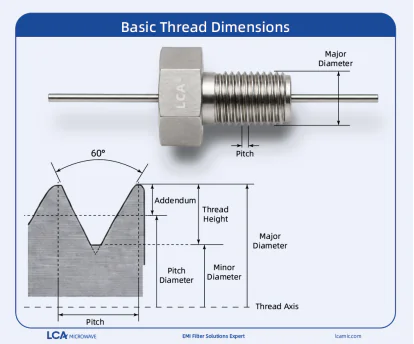
ISO Metric Threads Basic Dimensions chart
Metric Thread Coarse Pitch
Click Thread Link to check more data for each thread.
| Thread | (mm) | Basic Major Diameter | Basic Minor Diameter | Thread Height | |||
| (in) | (mm) | (in) | (mm) | (in) | (mm) | ||
| M1 | 0.25 | 0.0394 | 1 | 0.0287 | 0.729 | 0.0053 | 0.135 |
| M1.1 | 0.25 | 0.0433 | 1.1 | 0.0326 | 0.829 | 0.0053 | 0.135 |
| M1.2 | 0.25 | 0.0472 | 1.2 | 0.0366 | 0.929 | 0.0053 | 0.135 |
| M1.4 | 0.3 | 0.0551 | 1.4 | 0.0423 | 1.075 | 0.0064 | 0.162 |
| M1.6 | 0.35 | 0.063 | 1.6 | 0.0481 | 1.221 | 0.0074 | 0.189 |
| M1.8 | 0.35 | 0.0709 | 1.8 | 0.0559 | 1.421 | 0.0074 | 0.189 |
| M2 | 0.4 | 0.0787 | 2 | 0.0617 | 1.567 | 0.0085 | 0.217 |
| M2.2 | 0.45 | 0.0866 | 2.2 | 0.0674 | 1.713 | 0.0096 | 0.244 |
| M2.5 | 0.45 | 0.0984 | 2.5 | 0.0793 | 2.013 | 0.0096 | 0.244 |
| M3 | 0.5 | 0.1181 | 3 | 0.0968 | 2.459 | 0.0107 | 0.271 |
| M3.5 | 0.6 | 0.1378 | 3.5 | 0.1122 | 2.85 | 0.0128 | 0.325 |
| M4 | 0.7 | 0.1575 | 4 | 0.1276 | 3.242 | 0.0149 | 0.379 |
| M4.5 | 0.75 | 0.1772 | 4.5 | 0.1452 | 3.688 | 0.016 | 0.406 |
| M5 | 0.8 | 0.1969 | 5 | 0.1628 | 4.134 | 0.017 | 0.433 |
| M6 | 1 | 0.2362 | 6 | 0.1936 | 4.917 | 0.0213 | 0.541 |
| M7 | 1 | 0.2756 | 7 | 0.233 | 5.917 | 0.0213 | 0.541 |
| M8 | 1.25 | 0.315 | 8 | 0.2617 | 6.647 | 0.0267 | 0.677 |
| M9 | 1.25 | 0.3543 | 9 | 0.3011 | 7.647 | 0.0267 | 0.677 |
| M10 | 1.5 | 0.3937 | 10 | 0.3298 | 8.376 | 0.032 | 0.812 |
| M11 | 1.5 | 0.4331 | 11 | 0.3691 | 9.376 | 0.032 | 0.812 |
| M12 | 1.75 | 0.4724 | 12 | 0.3979 | 10.106 | 0.0373 | 0.947 |
| M14 | 2 | 0.5512 | 14 | 0.4659 | 11.835 | 0.0426 | 1.083 |
| M16 | 2 | 0.6299 | 16 | 0.5447 | 13.835 | 0.0426 | 1.083 |
| M18 | 2.5 | 0.7087 | 18 | 0.6061 | 15.394 | 0.0533 | 1.353 |
| M20 | 2.5 | 0.7874 | 20 | 0.6809 | 17.294 | 0.0533 | 1.353 |
| M22 | 2.5 | 0.8661 | 22 | 0.7596 | 19.294 | 0.0533 | 1.353 |
| M24 | 3 | 0.9449 | 24 | 0.817 | 20.752 | 0.0639 | 1.624 |
| M27 | 3 | 1.063 | 27 | 0.9351 | 23.752 | 0.0639 | 1.624 |
| M30 | 3.5 | 1.1811 | 30 | 1.0319 | 26.211 | 0.0746 | 1.894 |
| M33 | 3.5 | 1.2992 | 33 | 1.15 | 29.211 | 0.0746 | 1.894 |
| M36 | 4 | 1.4173 | 36 | 1.2469 | 31.67 | 0.0852 | 2.165 |
| M39 | 4 | 1.5354 | 39 | 1.365 | 34.67 | 0.0852 | 2.165 |
| M42 | 4.5 | 1.6535 | 42 | 1.4618 | 37.129 | 0.0959 | 2.436 |
| M45 | 4.5 | 1.7717 | 45 | 1.5799 | 40.129 | 0.0959 | 2.436 |
| M48 | 5 | 1.8898 | 48 | 1.6873 | 42.857 | 0.1065 | 2.706 |
| M52 | 5 | 2.0472 | 52 | 1.8448 | 46.857 | 0.1065 | 2.706 |
| M56 | 5.5 | 2.2047 | 56 | 1.9703 | 50.046 | 0.1172 | 2.977 |
| M60 | 5.5 | 2.3622 | 60 | 2.1278 | 54.046 | 0.1172 | 2.977 |
| M64 | 6 | 2.5197 | 64 | 2.264 | 57.505 | 0.1279 | 3.248 |
| M68 | 6 | 2.6772 | 68 | 2.4215 | 61.505 | 0.1279 | 3.248 |
Check Metric Coarse Threads Full Charts→
Metric Thread Fine Pitch
Click Thread Link to check more data for each thread.
| Thread | (mm) | Basic Major Diameter | Basic Minor Diameter | Thread Height | |||
| (in) | (mm) | (in) | (mm) | (in) | (mm) | ||
| M1 X 0.2 | 0.2 | 0.0394 | 1 | 0.0308 | 0.783 | 0.0043 | 0.108 |
| M1.1 X 0.2 | 0.2 | 0.0433 | 1.1 | 0.0348 | 0.883 | 0.0043 | 0.108 |
| M1.2 X 0.2 | 0.2 | 0.0472 | 1.2 | 0.0387 | 0.983 | 0.0043 | 0.108 |
| M1.4 X 0.2 | 0.2 | 0.0551 | 1.4 | 0.0466 | 1.183 | 0.0043 | 0.108 |
| M1.6 X 0.2 | 0.2 | 0.063 | 1.6 | 0.0544 | 1.383 | 0.0043 | 0.108 |
| M1.8 X 0.2 | 0.2 | 0.0709 | 1.8 | 0.0623 | 1.583 | 0.0043 | 0.108 |
| M2 X 0.25 | 0.25 | 0.0787 | 2 | 0.0681 | 1.729 | 0.0053 | 0.135 |
| M2.2 X 0.25 | 0.25 | 0.0866 | 2.2 | 0.0759 | 1.929 | 0.0053 | 0.135 |
| M2.5 X 0.35 | 0.35 | 0.0984 | 2.5 | 0.0835 | 2.121 | 0.0074 | 0.189 |
| M3 X 0.35 | 0.35 | 0.1181 | 3 | 0.1032 | 2.621 | 0.0074 | 0.189 |
| M3.5 X 0.35 | 0.35 | 0.1378 | 3.5 | 0.1229 | 3.121 | 0.0074 | 0.189 |
| M4 X 0.5 | 0.5 | 0.1575 | 4 | 0.1362 | 3.459 | 0.0107 | 0.271 |
| M4.5 X 0.5 | 0.5 | 0.1772 | 4.5 | 0.1559 | 3.959 | 0.0107 | 0.271 |
| M5 X 0.5 | 0.5 | 0.1969 | 5 | 0.1756 | 4.459 | 0.0107 | 0.271 |
| M6 X 0.75 | 0.75 | 0.2362 | 6 | 0.2043 | 5.188 | 0.016 | 0.406 |
| M7 X 0.75 | 0.75 | 0.2756 | 7 | 0.2436 | 6.188 | 0.016 | 0.406 |
| M8 X 0.75 | 0.75 | 0.315 | 8 | 0.283 | 7.188 | 0.016 | 0.406 |
| M8 X 1 | 1 | 0.315 | 8 | 0.2723 | 6.917 | 0.0213 | 0.541 |
| M9 X 0.75 | 0.75 | 0.3543 | 9 | 0.3224 | 8.188 | 0.016 | 0.406 |
| M9 X 1 | 1 | 0.3543 | 9 | 0.3117 | 7.917 | 0.0213 | 0.541 |
| M10 X 0.75 | 0.75 | 0.3937 | 10 | 0.3617 | 9.188 | 0.016 | 0.406 |
| M10 X 1 | 1 | 0.3937 | 10 | 0.3511 | 8.917 | 0.0213 | 0.541 |
| M10 X 1.25 | 1.25 | 0.3937 | 10 | 0.3404 | 8.647 | 0.0267 | 0.677 |
| M11 X 0.75 | 0.75 | 0.4331 | 11 | 0.4011 | 10.188 | 0.016 | 0.406 |
| M11 X 1 | 1 | 0.4331 | 11 | 0.3904 | 9.917 | 0.0213 | 0.541 |
| M12 X 1 | 1 | 0.4724 | 12 | 0.4298 | 10.917 | 0.0213 | 0.541 |
| M12 X 1.25 | 1.25 | 0.4724 | 12 | 0.4192 | 10.647 | 0.0267 | 0.677 |
| M12 X 1.5 | 1.5 | 0.4724 | 12 | 0.4085 | 10.376 | 0.032 | 0.812 |
| M14 X 1 | 1 | 0.5512 | 14 | 0.5085 | 12.917 | 0.0213 | 0.541 |
| M14 X 1.25 | 1.25 | 0.5512 | 14 | 0.4979 | 12.647 | 0.0267 | 0.677 |
| M14 X 1.5 | 1.5 | 0.5512 | 14 | 0.4872 | 12.376 | 0.032 | 0.812 |
| M16 X 1 | 1 | 0.6299 | 16 | 0.5873 | 14.917 | 0.0213 | 0.541 |
| M16 X 1.5 | 1.5 | 0.6299 | 16 | 0.566 | 14.376 | 0.032 | 0.812 |
| M18 X 1 | 1 | 0.7087 | 18 | 0.666 | 16.917 | 0.0213 | 0.541 |
| M18 X 1.5 | 1.5 | 0.7087 | 18 | 0.6447 | 16.376 | 0.032 | 0.812 |
| M18 X 2 | 2 | 0.7087 | 18 | 0.6234 | 15.835 | 0.0426 | 1.083 |
| M20 X 1 | 1 | 0.7874 | 20 | 0.7448 | 18.917 | 0.0213 | 0.541 |
| M20 X 1.5 | 1.5 | 0.7874 | 20 | 0.7235 | 18.376 | 0.032 | 0.812 |
| M20 X 2 | 2 | 0.7874 | 20 | 0.7022 | 17.835 | 0.0426 | 1.083 |
| M22 X 1 | 1 | 0.8661 | 22 | 0.8235 | 20.917 | 0.0213 | 0.541 |
| M22 X 1.5 | 1.5 | 0.8661 | 22 | 0.8022 | 20.376 | 0.032 | 0.812 |
| M22 X 2 | 2 | 0.8661 | 22 | 0.7809 | 19.835 | 0.0426 | 1.083 |
| M24 X 1 | 1 | 0.9449 | 24 | 0.9022 | 22.917 | 0.0213 | 0.541 |
| M24 X 1.5 | 1.5 | 0.9449 | 24 | 0.8809 | 22.376 | 0.032 | 0.812 |
| M24 X 2 | 2 | 0.9449 | 24 | 0.8596 | 21.835 | 0.0426 | 1.083 |
| M27 X 1 | 1 | 1.063 | 27 | 1.0204 | 25.917 | 0.0213 | 0.541 |
| M27 X 1.5 | 1.5 | 1.063 | 27 | 0.9991 | 25.376 | 0.032 | 0.812 |
| M27 X 2 | 2 | 1.063 | 27 | 0.9778 | 24.835 | 0.0426 | 1.083 |
| M30 X 1 | 1 | 1.1811 | 30 | 1.1385 | 28.917 | 0.0213 | 0.541 |
| M30 X 1.5 | 1.5 | 1.1811 | 30 | 1.1172 | 28.376 | 0.032 | 0.812 |
| M30 X 2 | 2 | 1.1811 | 30 | 1.0959 | 27.835 | 0.0426 | 1.083 |
| M30 X 3 | 3 | 1.1811 | 30 | 1.0532 | 26.752 | 0.0639 | 1.624 |
| M33 X 1.5 | 1.5 | 1.2992 | 33 | 1.2353 | 31.376 | 0.032 | 0.812 |
| M33 X 2 | 2 | 1.2992 | 33 | 1.214 | 30.835 | 0.0426 | 1.083 |
| M33 X 3 | 3 | 1.2992 | 33 | 1.1713 | 29.752 | 0.0639 | 1.624 |
| M36 X 1.5 | 1.5 | 1.4173 | 36 | 1.3534 | 34.376 | 0.032 | 0.812 |
| M36 X 2 | 2 | 1.4173 | 36 | 1.3321 | 33.835 | 0.0426 | 1.083 |
| M36 X 3 | 3 | 1.4173 | 36 | 1.2894 | 32.752 | 0.0639 | 1.624 |
| M39 X 1.5 | 1.5 | 1.5354 | 39 | 1.4715 | 37.376 | 0.032 | 0.812 |
| M39 X 2 | 2 | 1.5354 | 39 | 1.4502 | 36.835 | 0.0426 | 1.083 |
| M39 X 3 | 3 | 1.5354 | 39 | 1.4076 | 35.752 | 0.0639 | 1.624 |
| M42 X 1.5 | 1.5 | 1.6535 | 42 | 1.5896 | 40.376 | 0.032 | 0.812 |
| M42 X 2 | 2 | 1.6535 | 42 | 1.5683 | 39.835 | 0.0426 | 1.083 |
| M42 X 3 | 3 | 1.6535 | 42 | 1.5257 | 38.752 | 0.0639 | 1.624 |
| M42 X 4 | 4 | 1.6535 | 42 | 1.4831 | 37.67 | 0.0852 | 2.165 |
| M45 X 1.5 | 1.5 | 1.7717 | 45 | 1.7077 | 43.376 | 0.032 | 0.812 |
| M45 X 2 | 2 | 1.7717 | 45 | 1.6864 | 42.835 | 0.0426 | 1.083 |
| M45 X 3 | 3 | 1.7717 | 45 | 1.6438 | 41.752 | 0.0639 | 1.624 |
| M45 X 4 | 4 | 1.7717 | 45 | 1.6012 | 40.67 | 0.0852 | 2.165 |
| M48 X 1.5 | 1.5 | 1.8898 | 48 | 1.8258 | 46.376 | 0.032 | 0.812 |
| M48 X 2 | 2 | 1.8898 | 48 | 1.8045 | 45.835 | 0.0426 | 1.083 |
| M48 X 3 | 3 | 1.8898 | 48 | 1.7619 | 44.752 | 0.0639 | 1.624 |
| M48 X 4 | 4 | 1.8898 | 48 | 1.7193 | 43.67 | 0.0852 | 2.165 |
| M52 X 1.5 | 1.5 | 2.0472 | 52 | 1.9833 | 50.376 | 0.032 | 0.812 |
| M52 X 2 | 2 | 2.0472 | 52 | 1.962 | 49.835 | 0.0426 | 1.083 |
| M52 X 3 | 3 | 2.0472 | 52 | 1.9194 | 48.752 | 0.0639 | 1.624 |
| M52 X 4 | 4 | 2.0472 | 52 | 1.8768 | 47.67 | 0.0852 | 2.165 |
| M56 X 1.5 | 1.5 | 2.2047 | 56 | 2.1408 | 54.376 | 0.032 | 0.812 |
| M56 X 2 | 2 | 2.2047 | 56 | 2.1195 | 53.835 | 0.0426 | 1.083 |
| M56 X 3 | 3 | 2.2047 | 56 | 2.0769 | 52.752 | 0.0639 | 1.624 |
| M56 X 4 | 4 | 2.2047 | 56 | 2.0343 | 51.67 | 0.0852 | 2.165 |
| M60 X 1.5 | 1.5 | 2.3622 | 60 | 2.2983 | 58.376 | 0.032 | 0.812 |
| M60 X 2 | 2 | 2.3622 | 60 | 2.277 | 57.835 | 0.0426 | 1.083 |
| M60 X 3 | 3 | 2.3622 | 60 | 2.2343 | 56.752 | 0.0639 | 1.624 |
| M60 X 4 | 4 | 2.3622 | 60 | 2.1917 | 55.67 | 0.0852 | 2.165 |
| M64 X 1.5 | 1.5 | 2.5197 | 64 | 2.4557 | 62.376 | 0.032 | 0.812 |
| M64 X 2 | 2 | 2.5197 | 64 | 2.4344 | 61.835 | 0.0426 | 1.083 |
| M64 X 3 | 3 | 2.5197 | 64 | 2.3918 | 60.752 | 0.0639 | 1.624 |
| M64 X 4 | 4 | 2.5197 | 64 | 2.3492 | 59.67 | 0.0852 | 2.165 |
| M68 X 1.5 | 1.5 | 2.6772 | 68 | 2.6132 | 66.376 | 0.032 | 0.812 |
| M68 X 2 | 2 | 2.6772 | 68 | 2.5919 | 65.835 | 0.0426 | 1.083 |
| M68 X 3 | 3 | 2.6772 | 68 | 2.5493 | 64.752 | 0.0639 | 1.624 |
| M68 X 4 | 4 | 2.6772 | 68 | 2.5067 | 63.67 | 0.0852 | 2.165 |
Check Metric Fine Threads Full Charts→
Frequently Asked Questions
- What does the “M” mean in a thread designation?
The letter M indicates an ISO Metric Thread.
- What is the difference between M10 and M10 × 1.25?
M10 normally indicates the standard coarse-pitch thread, M10 × 1.25 indicates a fine-pitch thread, and M10 × 1.0 indicates a finer pitch.
- Are ISO Metric Threads compatible with UNC threads?
No. Although both use a 60° thread angle, they differ in dimensions, pitch, and designation.
- What are the most common metric thread sizes?
Common sizes include M3, M4, M5, M6, M8, M10, M12, M16, and M20.
- Which tolerance classes are most commonly used?
External threads commonly use 6g, while internal threads typically use 6H.
Engineering Support CTA: Selecting a threaded EMI filter or feedthrough capacitor? Share the thread standard and size, panel thickness, voltage/current, capacitance, and environmental requirements with LCA engineers. View Thread Mount Feedthrough Filters
Related Engineering Resources
Related LCA Products
Continue Exploring LCA Thread Engineering Center
ISO Metric Threads are the foundation of modern mechanical design and manufacturing. Whether you’re selecting fasteners, specifying threaded EMI filters, or comparing international thread standards, the LCA Thread Engineering Center provides detailed specifications, engineering guides, thread charts, and technical resources to help you make informed decisions.