Introduction
Quick Answer: Metric Coarse Threads are the standard thread series within the ISO Metric Thread system.
Metric Coarse Threads are the standard thread series within the ISO Metric Thread system. For each nominal diameter, the coarse thread uses the default pitch specified by ISO standards and is the most widely used thread type in industrial manufacturing.
Unless a different pitch is explicitly specified, a metric thread designation generally refers to the standard coarse pitch. Because of their versatility, ease of assembly, and broad availability, Metric Coarse Threads are used across virtually every industry, including machinery, electronics, construction, automotive, and industrial equipment.
Quick Definition
A Metric Coarse Thread is the standard-pitch version of an ISO Metric Thread. When only the nominal diameter is specified (for example, M8 or M12), the standard coarse pitch is normally assumed.
What Are Metric Coarse Threads?
Metric Coarse Threads use the standard pitch assigned to each nominal diameter by ISO standards.
For example:
| Thread Designation | Standard Coarse Pitch |
| M3 | 0.5 mm |
| M4 | 0.7 mm |
| M5 | 0.8 mm |
| M6 | 1.0 mm |
| M8 | 1.25 mm |
| M10 | 1.5 mm |
| M12 | 1.75 mm |
These pitch values are standardized, making Metric Coarse Threads the default choice for most mechanical fastening applications.
History & Development
The ISO Metric Thread system was developed to provide a globally standardized screw thread system based on metric dimensions.
Within this system, the coarse thread series became the default because it offers an effective balance between strength, manufacturing simplicity, assembly speed, and interchangeability.
Today, Metric Coarse Threads are the preferred choice for the majority of commercial and industrial fastening applications worldwide.
Understanding Metric Coarse Thread Designations
A standard metric thread designation follows this format:
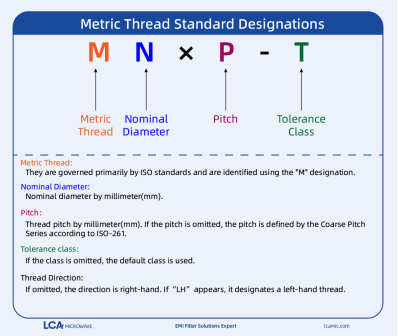
M N × P – T
M Nominal Diameter × Pitch – Tolerance Class
M (Metric Thread):
They are governed primarily by ISO standards and are identified using the “M” designation.
Nominal Diameter:
Nominal diameter by millimeter(mm).
Pitch:
Thread pitch by millimeter(mm). If the pitch is omitted, the pitch is defined by the Coarse Pitch Series according to lSO-261.
Tolerance class:
If the class is omitted, the default class is used.
Thread Direction:
If omitted, the direction is right-hand. If“LH” appears, it designates a left-hand thread.
Example:
M12 × 1.75 – 6g
| Element | Description |
| M | Metric Thread |
| 12 | Nominal Diameter (mm) |
| 1.75 | Thread Pitch (mm) |
| 6g | External Thread Tolerance |
Internal threads typically use 6H, while external threads commonly use 6g.
If the pitch is omitted (e.g., M8), it normally indicates the standard coarse pitch for that diameter.
Advantages of Metric Coarse Threads
Metric Coarse Threads offer numerous advantages:
- Standardized worldwide.
- Faster installation and removal.
- Excellent availability of fasteners and tooling.
- Better resistance to minor thread damage.
- More tolerant of dirt and contamination.
- Easier manufacturing and inspection.
- Suitable for general-purpose engineering.
These characteristics make Metric Coarse Threads the preferred option for most threaded assemblies.
Limitations
Although highly versatile, Metric Coarse Threads may not be ideal when:
- Precise axial adjustment is required.
- Thin-wall components require additional thread engagement.
- Specialized engineering standards specify a fine pitch.
- Compact designs demand a smaller thread lead per revolution..
Typical Applications
Metric Coarse Threads are widely used in:
- Industrial machinery
- Electrical enclosures
- Consumer products
- Robotics
- Automation systems
- Construction equipment
- Automotive components
- General fastening
- Threaded feedthrough filters
- EMI shielding enclosures
How to Choose Metric Coarse Threads
Choose Metric Coarse Threads when:
- General-purpose fastening is required.
- Ease of assembly is important.
- Standard hardware is preferred.
- Components are frequently assembled and disassembled.
- The engineering drawing does not specify a fine pitch.
Metric Coarse vs Metric Fine
| Feature | Metric Coarse | Metric Fine |
| Pitch | Larger | Smaller |
| Threads per Length | Fewer | More |
| Assembly Speed | Faster | Slower |
| Damage Tolerance | Better | Lower |
| Fastener Availability | Excellent | Good |
| General Applications | Excellent | Specialized |
Industry Standards
Metric Coarse Threads are defined by:
- ISO 68-1
- ISO 261
- ISO 724
- ISO 965
Metric Coarse Threads Basic Dimensions chart
Click Thread Link to check more data for each thread.
| Thread | (mm) | Basic Major Diameter | Basic Minor Diameter | Thread Height | |||
| (in) | (mm) | (in) | (mm) | (in) | (mm) | ||
| M1 | 0.25 | 0.0394 | 1 | 0.0287 | 0.729 | 0.0053 | 0.135 |
| M1.1 | 0.25 | 0.0433 | 1.1 | 0.0326 | 0.829 | 0.0053 | 0.135 |
| M1.2 | 0.25 | 0.0472 | 1.2 | 0.0366 | 0.929 | 0.0053 | 0.135 |
| M1.4 | 0.3 | 0.0551 | 1.4 | 0.0423 | 1.075 | 0.0064 | 0.162 |
| M1.6 | 0.35 | 0.063 | 1.6 | 0.0481 | 1.221 | 0.0074 | 0.189 |
| M1.8 | 0.35 | 0.0709 | 1.8 | 0.0559 | 1.421 | 0.0074 | 0.189 |
| M2 | 0.4 | 0.0787 | 2 | 0.0617 | 1.567 | 0.0085 | 0.217 |
| M2.2 | 0.45 | 0.0866 | 2.2 | 0.0674 | 1.713 | 0.0096 | 0.244 |
| M2.5 | 0.45 | 0.0984 | 2.5 | 0.0793 | 2.013 | 0.0096 | 0.244 |
| M3 | 0.5 | 0.1181 | 3 | 0.0968 | 2.459 | 0.0107 | 0.271 |
| M3.5 | 0.6 | 0.1378 | 3.5 | 0.1122 | 2.85 | 0.0128 | 0.325 |
| M4 | 0.7 | 0.1575 | 4 | 0.1276 | 3.242 | 0.0149 | 0.379 |
| M4.5 | 0.75 | 0.1772 | 4.5 | 0.1452 | 3.688 | 0.016 | 0.406 |
| M5 | 0.8 | 0.1969 | 5 | 0.1628 | 4.134 | 0.017 | 0.433 |
| M6 | 1 | 0.2362 | 6 | 0.1936 | 4.917 | 0.0213 | 0.541 |
| M7 | 1 | 0.2756 | 7 | 0.233 | 5.917 | 0.0213 | 0.541 |
| M8 | 1.25 | 0.315 | 8 | 0.2617 | 6.647 | 0.0267 | 0.677 |
| M9 | 1.25 | 0.3543 | 9 | 0.3011 | 7.647 | 0.0267 | 0.677 |
| M10 | 1.5 | 0.3937 | 10 | 0.3298 | 8.376 | 0.032 | 0.812 |
| M11 | 1.5 | 0.4331 | 11 | 0.3691 | 9.376 | 0.032 | 0.812 |
| M12 | 1.75 | 0.4724 | 12 | 0.3979 | 10.106 | 0.0373 | 0.947 |
| M14 | 2 | 0.5512 | 14 | 0.4659 | 11.835 | 0.0426 | 1.083 |
| M16 | 2 | 0.6299 | 16 | 0.5447 | 13.835 | 0.0426 | 1.083 |
| M18 | 2.5 | 0.7087 | 18 | 0.6061 | 15.394 | 0.0533 | 1.353 |
| M20 | 2.5 | 0.7874 | 20 | 0.6809 | 17.294 | 0.0533 | 1.353 |
| M22 | 2.5 | 0.8661 | 22 | 0.7596 | 19.294 | 0.0533 | 1.353 |
| M24 | 3 | 0.9449 | 24 | 0.817 | 20.752 | 0.0639 | 1.624 |
| M27 | 3 | 1.063 | 27 | 0.9351 | 23.752 | 0.0639 | 1.624 |
| M30 | 3.5 | 1.1811 | 30 | 1.0319 | 26.211 | 0.0746 | 1.894 |
| M33 | 3.5 | 1.2992 | 33 | 1.15 | 29.211 | 0.0746 | 1.894 |
| M36 | 4 | 1.4173 | 36 | 1.2469 | 31.67 | 0.0852 | 2.165 |
| M39 | 4 | 1.5354 | 39 | 1.365 | 34.67 | 0.0852 | 2.165 |
| M42 | 4.5 | 1.6535 | 42 | 1.4618 | 37.129 | 0.0959 | 2.436 |
| M45 | 4.5 | 1.7717 | 45 | 1.5799 | 40.129 | 0.0959 | 2.436 |
| M48 | 5 | 1.8898 | 48 | 1.6873 | 42.857 | 0.1065 | 2.706 |
| M52 | 5 | 2.0472 | 52 | 1.8448 | 46.857 | 0.1065 | 2.706 |
| M56 | 5.5 | 2.2047 | 56 | 1.9703 | 50.046 | 0.1172 | 2.977 |
| M60 | 5.5 | 2.3622 | 60 | 2.1278 | 54.046 | 0.1172 | 2.977 |
| M64 | 6 | 2.5197 | 64 | 2.264 | 57.505 | 0.1279 | 3.248 |
| M68 | 6 | 2.6772 | 68 | 2.4215 | 61.505 | 0.1279 | 3.248 |
Check Metric Coarse Threads Full Charts→
Frequently Asked Questions
- Is M10 a coarse thread?
Yes. Unless otherwise specified, M10 refers to the standard coarse thread M10 × 1.5.
- Are Metric Coarse Threads stronger than Metric Fine Threads?
Not necessarily. Thread performance depends on material, engagement length, preload, and application requirements.
- Why are Metric Coarse Threads more common?
Because they are standardized, easier to manufacture, more tolerant of damage, and suitable for most industrial applications.
- Can a coarse thread mate with a fine thread?
No. Threads with different pitches are not compatible.
Engineering Support CTA: Selecting a threaded EMI filter or feedthrough capacitor? Share the thread standard and size, panel thickness, voltage/current, capacitance, and environmental requirements with LCA engineers. View Thread Mount Feedthrough Filters
Related Engineering Resources
Related LCA Products
Continue Exploring LCA Thread Engineering Center
Metric Coarse Threads are the foundation of most ISO Metric fastening systems. Explore additional engineering guides, thread charts, and specification pages within the LCA Thread Engineering Center to select the right thread for your application.