M9 × 1 Thread Quick Specifications
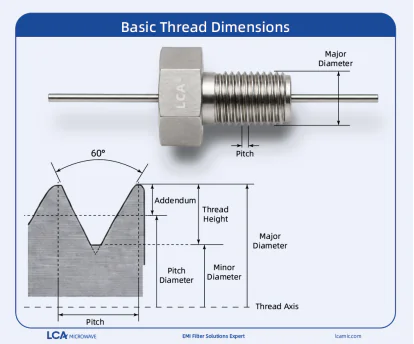
| Parameter | Specification | |
| Thread Standard | ISO Metric Threads | |
| Major Diameter | 9.0mm | 0.3543 in |
| Pitch | 1 mm | 0.0394 in |
| Pitch Diameter | 8.35 mm | 0.3287 in |
| Minor Diameter | 7.917 mm | 0.3117 in |
| Thread Height | 0.541 mm | 0.0213 in |
| Addendum | 0.325 mm | 0.0128 in |
| Thread Angle | 60° | |
Introduction
The M9 × 1 thread is an ISO metric fine thread designed for applications requiring higher positioning accuracy, improved adjustment resolution, and increased thread engagement within a limited axial length.
Compared with the standard M9 × 1.25 coarse thread, the M9 × 1 thread features a smaller pitch, allowing more threads to engage over the same distance. This makes it suitable for precision mechanical assemblies where accurate positioning and controlled adjustment are more important than rapid assembly.
This guide provides comprehensive technical information covering M9 × 1 thread dimensions, ISO standards, tolerance classes, engineering considerations, and practical design guidance.
Quick Answer: The M9 × 1 thread is an ISO metric fine thread designed for applications requiring higher positioning accuracy, improved adjustment resolution, and increased thread engagement within a limited axial length.
An M9 × 1 thread is an ISO metric fine thread.
Its designation indicates:
- M= ISO Metric Thread
- 9= Nominal major diameter of 9 mm
- 1= Thread pitch of 1 mm
Unlike the standard M9 coarse thread (1.25 mm pitch), the M9 × 1 thread provides a finer lead, enabling more precise adjustment and greater thread engagement over the same threaded length.
Understanding the M9 × 1 Designation
Unlike the coarse M9 designation, the pitch must be included because multiple pitch options exist for the same nominal diameter.
Thread Tolerance Classes
Tolerance classes define the permissible dimensional variation of a thread and determine how external and internal threads fit together during assembly.
For ISO metric fine threads such as M9×1, tolerance classes are specified in accordance with ISO 965-1 and ISO 965-2.
A complete designation combines a tolerance grade (numerical value) and a tolerance position (letter).
For example:
M9 × 1 – 6g
where:
- 6 = Tolerance grade
- g = External threadstolerance position
The corresponding internal thread is typically:
M9 × 1 – 6H
Common Tolerance Classes
| Thread Type | Common Class | Typical Application |
| External Thread | 6g | General-purpose screws and bolts |
| Internal Thread | 6H | General-purpose tapped holes and nuts |
| External Thread | 4g6g | Precision mechanical assemblies |
| External Thread | 8g | Loose fit or coated fasteners |
| Internal Thread | 5H | Higher positioning accuracy |
M9 Coarse Thread vs M9 Fine Thread
Many engineers are unaware that M4.5 is available in more than one pitch.
The two most common versions are:
| Thread | Pitch | Standard Use |
| M9 × 1.25 | 1.25 mm | Standard coarse thread |
| M9 × 1 | 1 mm | Fine thread |
M9 × 1.25 (Coarse)
Advantages:
- Easier assembly
- Better resistance to cross-threading
- Faster installation
- More tolerant of contamination
- Preferred for general-purpose fastening
Typical applications:
- Consumer electronics
- Industrial equipment
- Enclosures
- Control panels
M9 × 1 (Fine)
Advantages:
- More precise axial adjustment
- Greater number of engaged threads within the same length
- Better resistance to self-loosening under certain conditions
Typical applications:
- Optical instruments
- Precision measuring devices
- Fine adjustment mechanisms
Frequently Asked Questions (FAQ)
Q1. Is M9 × 1 a standard thread?
Yes. M9 × 1 is a standardized ISO metric fine thread defined by ISO standards, although it is less commonly used than the standard M9 × 1.25 coarse thread.
Q2. Is M9 × 1 the same as M9?
Not exactly.
When a drawing specifies only M9, it usually refers to the standard M9 × 1.25 coarse thread.
The fine-pitch version must always be written as:
M9 × 1
to avoid manufacturing or purchasing errors.
Q3. What is the difference between M9 × 1 and M9 × 1.25?
The difference is thread pitch.
Q4. Can LCA provide EMI filters with M9 threads?
Yes. LCA supports customized mechanical designs involving metric and inch thread configurations.
Customization options include:
- Thread size
- Housing dimensions
- Electrical parameters
- Sealing structure
- Plating options
Engineering Support CTA: Selecting a threaded EMI filter or feedthrough capacitor? Share the thread standard and size, panel thickness, voltage/current, capacitance, and environmental requirements with LCA engineers. View Thread Mount Feedthrough Filters
Related Engineering Resources
- Unified Thread Standard
- UNC Threads
- UNF Threads
- UNEF Threads
- Metric Threads
- Metric Coarse Threads
- Metric Fine Threads