Quick Definition
Quick Answer: A Thread is a helical ridge formed on the surface of a cylindrical or conical component.
A Thread is a helical ridge formed on the surface of a cylindrical or conical component. Threads are used to create mechanical connections, transmit motion, or provide adjustable positioning between components.
What Is a Thread?
A thread is a continuous spiral structure created by wrapping a profile around a cylindrical surface.
Threads are commonly found on:
- Screws
- Bolts
- Nuts
- Threaded connectors
- Pipe fittings
- Mechanical components
- Thread Mount Feedthrough Filters
By allowing two threaded components to engage with each other, threads provide a reliable method for fastening, adjustment, and mechanical transmission.
Why Are Threads Important?
Threads are one of the most widely used mechanical connection methods because they provide:
- Secure fastening
- Easy assembly and disassembly
- Adjustable positioning
- High load-carrying capability
- Compact mechanical design
In engineering applications, proper thread selection is essential to ensure compatibility, mechanical strength, and long-term reliability.
Common Thread Types
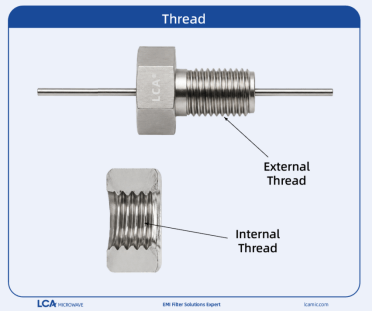
External Thread
An external thread is formed on the outside surface of a component.
Examples:
- Bolts
- Screws
- Threaded studs
- Threaded EMI filters
Internal Thread
An internal thread is formed inside a hole or component.
Examples:
- Nuts
- Threaded mounting holes
- Threaded housings
Common Thread Standards
Different industries use different thread standards.
| Standard | Application |
| ISO Metric Thread | Global mechanical applications |
| Unified Thread Standard (UNC/UNF) | North America and industrial applications |
| BSP Thread | Pipe connections |
| NPT Thread | Tapered pipe connections |
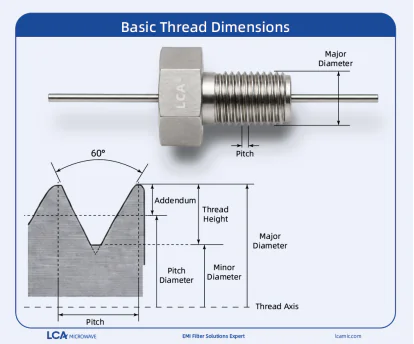
Basic Thread Dimensions
Important thread parameters include:
These dimensions define thread size, fit, and performance.
Frequently Asked Questions
- What are the main types of threads?
The most common types include Metric threads, Unified threads (UNC/UNF), pipe threads, and special-purpose threads.
- What is the difference between internal and external threads?
External threads are formed on the outside of a component, while internal threads are formed inside a hole.
- How is a thread identified?
A thread is identified by parameters such as diameter, pitch, thread angle, and applicable standard.
- Why are thread standards important?
Standards ensure compatibility between components manufactured by different suppliers.
Engineering Support CTA: Selecting a threaded EMI filter or feedthrough capacitor? Share the thread standard and size, panel thickness, voltage/current, capacitance, and environmental requirements with LCA engineers. View Thread Mount Feedthrough Filters
Related Engineering Resources
- Unified Thread Standard
- UNC Threads
- UNF Threads
- UNEF Threads
- Metric Threads
- Metric Coarse Threads
- Metric Fine Threads