Introduction
Quick Answer: Thread standards define the dimensions, profiles, tolerances, and designation systems that ensure threaded components are interchangeable across manufacturers and industries.
Thread standards define the dimensions, profiles, tolerances, and designation systems that ensure threaded components are interchangeable across manufacturers and industries.
The LCA Thread Standards Library provides a structured overview of the world’s most commonly used screw thread standards, helping engineers understand where each system is used, how it is designated, and how different standards compare.
What Is a Thread Standard?
A thread standard is a defined system of rules and dimensions used to manufacture and identify compatible screw threads.
Following a recognized standard allows manufacturers and users to produce and source mating threaded components with predictable compatibility.
Why Are Thread Standards Important?
Without standardized thread dimensions, components manufactured by different companies would often be incompatible.
Thread standards provide:
- Interchangeability
- Consistent dimensions
- Predictable thread fit
- Standardized inspection
- Easier global sourcing
- Consistent engineering documentation
- Simplified maintenance and replacement
For manufacturers supplying international markets, correctly identifying the required thread standard is especially important.
Browse Thread Standards
Unified Thread Standard (UTS)
The Unified Thread Standard is a major inch-based screw thread system used primarily in North America.
UNC — Unified National Coarse
A coarse-pitch series within the Unified Thread Standard.
UNF — Unified National Fine
A fine-pitch series within the Unified Thread Standard.
UNEF — Unified National Extra Fine
An extra-fine-pitch Unified thread series used where a finer pitch is required.
UNS — Unified Special
A Unified thread designation used for special or non-standard diameter/pitch combinations covered by the Unified system.
ISO Metric Threads
ISO Metric Threads are the most widely used general-purpose screw thread system internationally.
They use millimeters for nominal diameter and pitch and are identified using the M designation.
Metric Coarse Threads
Standard coarse-pitch metric threads for general-purpose applications.
Explore Metric Coarse Threads →
Metric Fine Threads
Metric threads using a finer pitch than the standard coarse thread for the same nominal diameter.
Pipe Thread Standards
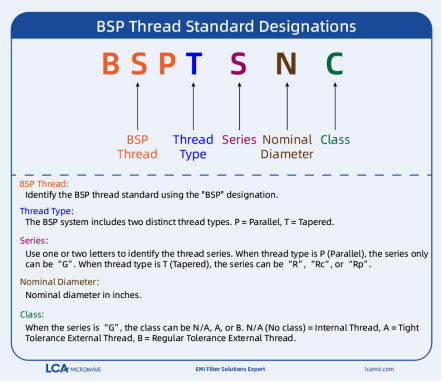
BSP Threads
The British Standard Pipe thread family is widely used for pipe connections and fluid systems.
BSPP
British Standard Pipe Parallel thread.
BSPT
British Standard Pipe Taper thread.
NPT Threads
National Pipe Thread (NPT) is a widely used tapered pipe thread standard, particularly in North America.
NPTF
National Pipe Taper Fuel thread, designed for applications requiring a tighter dry-seal arrangement.
Thread Standards Comparison
| Feature | ISO Metric | UNC | UNF | BSP | NPT |
| Primary System | Metric | Inch | Inch | Inch | Inch |
| Pitch Definition | mm | TPI | TPI | TPI | TPI |
| Typical Use | General machinery | General fastening | Fine fastening | Pipe systems | Pipe systems |
| Thread Angle | 60° | 60° | 60° | 55° | 60° |
| Typical Region | International | North America | North America | UK / International | North America |
LCA Engineering Services
Selecting the right thread is only one aspect of successful product integration.
LCA provides engineering support throughout the development process, helping customers optimize both the mechanical and electrical performance of threaded EMI components.
Frequently Asked Questions
Q1: What is the most common thread standard?
ISO Metric Threads are the most widely used general-purpose screw thread system globally, while Unified threads remain particularly important in North American applications.
Q2: What is the difference between UNC and UNF?
UNC uses a coarser pitch, while UNF uses a finer pitch for the same nominal diameter.
Q3: What thread standard should I use?
The correct standard depends on the mating component, engineering requirements, application, regional practice, and applicable industry standard. Always verify the complete thread designation before selecting a replacement.
Q4: Where can I find detailed dimensions for a specific thread?
Visit the Thread Specifications section to find individual thread sizes such as M6, M10, #4-40 UNC, and other specifications.
Related Thread Resources
Thread Definitions
Understand Major Diameter, Pitch Diameter, Thread Pitch, Thread Class, and other engineering terms.
Thread Specifications
Find detailed dimensional information for individual thread sizes.
Explore Thread Specifications →
Thread Engineering Guides
Learn how to identify, measure, compare, and select threads.
Explore Thread Engineering Guides →
Thread Charts
Quickly reference common thread sizes, pitches, diameters, and other data.
Continue Exploring the LCA Thread Engineering Center
Explore international thread standards, compare different systems, and find the detailed specifications needed for your application.
Thread Definitions → Thread Standards → Thread Specifications → Thread Engineering Guides
Engineering Support CTA: Selecting a threaded EMI filter or feedthrough capacitor? Share the thread standard and size, panel thickness, voltage/current, capacitance, and environmental requirements with LCA engineers. View Thread Mount Feedthrough Filters