Introduction
Quick Answer: National Pipe Thread (NPT) is the most widely used pipe thread system in the United States and Canada for joining pipes, valves, fittings, sensors, hydraulic equipment, and pneumatic components.
National Pipe Thread (NPT) is the most widely used pipe thread system in the United States and Canada for joining pipes, valves, fittings, sensors, hydraulic equipment, and pneumatic components.
Like BSP, NPT belongs to the pipe thread family, but it differs significantly in thread profile, thread angle, taper, and sealing method. NPT threads are standardized by the American Society of Mechanical Engineers (ASME) and are commonly specified throughout North America.
The NPT system includes two primary thread types:
- NPT (National Pipe Taper)
- NPTF (National Pipe Taper Fuel / Dryseal)
Understanding the differences between these thread types is essential to selecting compatible pipe fittings and preventing leakage.
Quick Definition
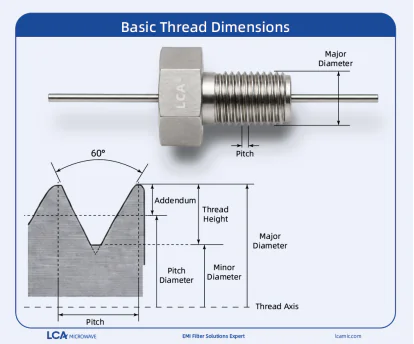
NPT (National Pipe Thread) is a tapered pipe thread system defined by ASME for creating mechanical joints in piping systems. It uses a 60° thread profile and relies on thread interference, often with thread sealant, to achieve pressure-tight connections.
What Are NPT Threads?
NPT threads are designed primarily for connecting pipes and fittings carrying liquids or gases.
Unlike straight machine threads used for fastening components, NPT threads feature a 1:16 taper. As the male and female threads are tightened together, the taper creates an interference fit that helps produce a pressure-resistant seal.
In many applications, PTFE thread tape or pipe thread sealant is applied to improve sealing performance.
NPT threads are widely used in:
- Hydraulic systems
- Pneumatic systems
- Fuel systems
- Process instrumentation
- Pressure sensors
- Industrial automation
- Oil and gas equipment
History & Development
NPT was developed in North America to standardize threaded pipe connections across industries.
Today, the system is defined by ASME B1.20.1, which specifies the dimensions and requirements for general-purpose pipe threads. Over time, specialized variants such as NPTF (Dryseal) were introduced to improve sealing performance without relying as heavily on sealing compounds.
NPT remains the dominant pipe thread system in the United States and Canada and is widely supported by manufacturers of valves, fittings, gauges, and industrial equipment.
Types of NPT Threads
The NPT family includes two major thread types:
| Thread Type | Description |
| NPT | Standard tapered pipe thread |
| NPTF | Dryseal tapered pipe thread |
Although both use the same basic taper and thread profile, their sealing characteristics differ.
NPT Threads
Standard NPT threads rely on the interference between mating tapered threads to create a mechanical joint.
To achieve a reliable pressure-tight seal, thread sealant or PTFE tape is typically recommended.
Typical applications include:
- Water systems
- Pneumatic equipment
- Hydraulic systems
- Industrial piping
- Instrumentation
NPTF Threads (Dryseal)
NPTF (National Pipe Taper Fuel), often referred to as Dryseal threads, are designed to provide a tighter seal between mating threads.
Compared with standard NPT threads, NPTF threads have modified crest and root tolerances that reduce the spiral leakage path when manufactured and assembled correctly.
Because of this design, NPTF is commonly specified in:
- Fuel systems
- Hydraulic circuits
- High-pressure pneumatic systems
- Aerospace equipment
- Military applications
Although sealant may still be used in some applications, NPTF is intended to achieve sealing primarily through thread interference.
NPT vs NPTF
| Feature | NPT | NPTF |
| Thread Form | Tapered | Tapered |
| Thread Angle | 60° | 60° |
| Taper | 1:16 | 1:16 |
| Sealing Method | Sealant usually recommended | Dryseal design |
| Typical Applications | General industrial piping | Fuel, hydraulic, aerospace |
Advantages of NPT Threads
NPT threads offer several advantages:
- Standard throughout North America.
- Strong mechanical engagement due to taper.
- Broad availability of fittings and tooling.
- Suitable for a wide range of pressure applications.
- Supported by extensive ASME standards.
Limitations
Potential limitations include:
- Not interchangeable with BSP threads.
- Proper installation torque is important.
- Sealant is typically required for standard NPT.
- Repeated assembly may affect sealing performance.
Typical Applications
NPT threads are widely used in:
- Hydraulic equipment
- Pneumatic systems
- Oil & gas
- Water treatment
- Pressure instrumentation
- Industrial automation
- Process control
- Pumps
- Valves
- Sensor housings
How to Choose NPT Threads
Choose NPT when:
- General-purpose pipe connections are required.
- Thread sealant can be used.
- Standard North American fittings are specified.
Choose NPTF when:
- Reduced leakage is critical.
- Fuel or hydraulic systems are involved.
- Dryseal performance is required by the specification.
NPT vs BSP
| Feature | NPT | BSP |
| Thread Angle | 60° | 55° |
| Thread Profile | Unified | Whitworth |
| Taper | Yes | BSPT only |
| Main Standards | ASME B1.20.1 | ISO 7-1 / ISO 228-1 |
| Main Regions | North America | Europe, Asia, Australia |
Despite similar appearances, NPT and BSP threads are not interchangeable because of differences in thread angle, profile, taper, and dimensions.
Industry Standards
NPT threads are primarily defined by:
- ASME B1.20.1— Pipe Threads, General Purpose (Inch)
- ASME B1.20.3— Dryseal Pipe Threads (Inspection)
- SAEand other industry standards reference NPT/NPTF for specific applications
Frequently Asked Questions
- What does NPT stand for?
National Pipe Thread, the standard tapered pipe thread system used primarily in North America.
- What is the difference between NPT and NPTF?
NPT typically relies on thread sealant for leak prevention, while NPTF (Dryseal) is designed to minimize leakage through tighter thread engagement.
- Can NPT be connected to BSP?
No. Although some sizes may appear similar, differences in thread angle, profile, taper, and dimensions make them incompatible for reliable sealing.
- Why do NPT threads use a taper?
The taper creates interference between the mating threads, helping to produce a pressure-tight joint.
- What is the taper of NPT threads?
Standard NPT threads use a 1:16 taper.
Engineering Support CTA: Selecting a threaded EMI filter or feedthrough capacitor? Share the thread standard and size, panel thickness, voltage/current, capacitance, and environmental requirements with LCA engineers. View Thread Mount Feedthrough Filters
Related Engineering Resources
Continue Exploring LCA Thread Engineering Center
National Pipe Threads (NPT) are the foundation of pipe connections throughout North America. Explore the LCA Thread Engineering Center for detailed NPT and NPTF guides, pipe thread comparison articles, thread charts, and engineering resources to help you select compatible threaded components for industrial and fluid system applications.