Requesting a custom EMI filter is more than simply providing a capacitance value or circuit diagram. To design an effective solution, manufacturers typically require a combination of electrical specifications, mechanical constraints, environmental conditions, and qualification requirements.
Providing complete project information at the beginning of the design process helps reduce engineering iterations, improve quotation accuracy, and shorten prototype lead times.
Based on LCA’s experience supporting aerospace, defense, industrial automation, RF communication, and medical equipment manufacturers, the following information is typically required when developing a custom EMI filter.
The Critical Need for Custom Filters in Complex Electronics
When hardware engineers face stringent electromagnetic compatibility (EMC) regulations, standard off-the-shelf emi components often fall short. Modern aerospace, defense, and high-frequency communication systems operate in dense electronic environments where a generic passive emi filter cannot adequately address specific noise profiles or fit within severely restricted mechanical envelopes.
In these scenarios, engaging with professional EMC filter design services becomes necessary. However, designing a highly effective emi noise suppressor—whether it is a specialized high frequency filter or a rugged emi power filter—requires precise communication between the design engineer and the capacitor manufacturers. Providing a complete and accurate specification package upfront eliminates guesswork, accelerates prototyping, and ensures the resulting custom filters function exactly as intended.
Through this guide, we outline the exact electrical, mechanical, and environmental information you must provide to your capacitor suppliers to guarantee a successful custom EMI filter design.
Essential Electrical Specifications
The primary function of an emi filter is to allow desired power or signals to pass while blocking unwanted radio frequency interference. To tune the electrical filter correctly, provide the following:
- Operating Voltage and Current: Specify the maximum continuous working voltage (VDC or VAC) and the maximum operating current. If the system experiences transient spikes, this must be noted so the manufacturer can select appropriate high-power capacitors or varistors.
- Frequency Response and Insertion Loss: Do not just specify a capacitance value. Clearly state the target insertion loss (in dB) across the specific frequency range (e.g., “minimum 40 dB attenuation from 100 MHz to 1 GHz”). This tells the designer whether to use a simple C-circuit capacitor filter or a multi-stage Pi-circuit emi suppression filter.
- Signal Type and Data Rate: If the filter is for a data line rather than a power line, specify the maximum data rate or clock frequency. An improperly specified signal filter might distort high-speed digital signals by rolling off the intended frequency alongside the emi noise.
Mechanical and Environmental Constraints
The physical operating environment heavily influences the materials and construction of an electromagnetic interference filter.
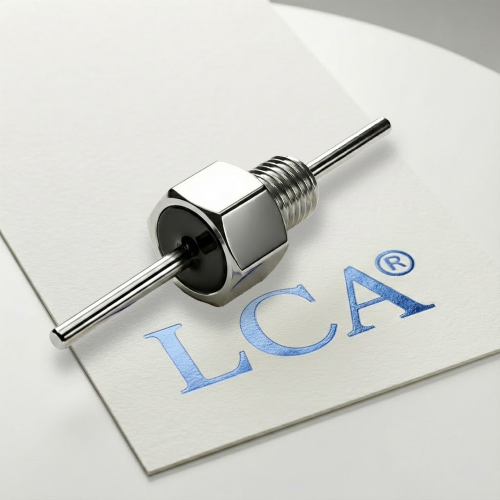
- Footprint and Mounting: Provide maximum allowable dimensions (length, diameter, thread size). Specify if the filter will be a threaded mount, a capacitive feedthrough, or one of our solder-in feedthrough filters.
- Hermeticity: If the equipment operates in a vacuum, at high altitudes, or in highly corrosive environments, explicitly state the need for a hermetically sealed design to prevent moisture ingress and outgassing.
- Operating Temperature: State the continuous operating temperature range. This dictates the type of ceramic capacitor dielectric used (e.g., C0G for high stability across temperatures, or X7R).
Custom EMI Filter Specification Checklist
| Item | Required? | Why It Matters |
| Operating Voltage | ✔ | Insulation selection |
| Operating Current | ✔ | Thermal design |
| Frequency Range | ✔ | Filter topology |
| Target Insertion Loss | ✔ | EMC performance |
| Mechanical Drawing | ✔ | Package design |
| Mounting Style | ✔ | Installation |
| Operating Temperature | ✔ | Material selection |
| Humidity / Salt Fog | Optional | Environmental reliability |
| Qualification Standard | Optional | Production screening |
| Annual Quantity | Optional | Cost optimization |
Procurement Guide for Purchasing Engineers
When sourcing custom filters, purchasing teams act as the bridge between internal engineering and external capacitor suppliers. To ensure a smooth quoting and production process:
- Consolidate the Datasheet: Ensure all the parameters listed above are documented in a single control drawing or specification sheet.
- Define Qualification Standards: State upfront if the emi emc suppression component must comply with specific military standards (e.g., MIL-PRF-15733) or commercial EMC limits (like CISPR 32).
- Volume and Prototyping: Custom rf filters require an initial engineering and tooling phase. Clearly communicate prototype quantities required for first-article inspection, as well as the projected annual volume for mass production.
Conclusion
A successful custom EMI filter project relies entirely on the quality of information provided at the outset. By thoroughly defining the electrical limits, mechanical dimensions, and environmental stresses, engineers allow EMC filter design services to engineer a precise, reliable emi noise suppressor. Taking the time to detail these specifications ensures that your custom high frequency filter will seamlessly integrate into your system and conquer any compliance challenge.
Frequently Asked Questions
Q: Can I just provide a schematic of my circuit and ask for an EMI filter recommendation?
While a schematic is helpful, it is not sufficient. Manufacturers need the physical constraints, environmental conditions, and specific insertion loss targets to engineer the physical electromagnetic filter.
Q: Does requesting custom filters significantly increase lead times?
Initially, yes, due to the engineering, prototyping, and validation phases. However, once the custom rf interference filter is qualified and approved, production lead times align closely with standard electronic components.
Q: Are custom EMI filters always more expensive than standard catalog items?
While tooling and NRE (Non-Recurring Engineering) costs apply upfront, a custom emi power filter can actually save money by eliminating the need for bulky secondary shielding, extra PCB layers, or late-stage redesigns due to EMC failure.
Need Help Specifying a Custom EMI Filter for Your Project?
If your hardware faces unique space constraints or severe RF interference, LCA’s engineering team is ready to assist. We provide full-cycle EMC filter design services tailored to your exact specifications. Contact LCA today to discuss your custom filtration needs.
Need Help Specifying a Custom EMI Filter for Your Mission-Critical System?
Every advanced electronic application is different — and so is every electromagnetic interference challenge. LCA’s engineering team can help you understand design constraints, RF performance, and qualification requirements — and recommend the right custom filters and EMI components for your specific needs. Contact LCA today for one-to-one technical support and customized EMC filter design services.