What Is a Threaded Mount EMI Filter?
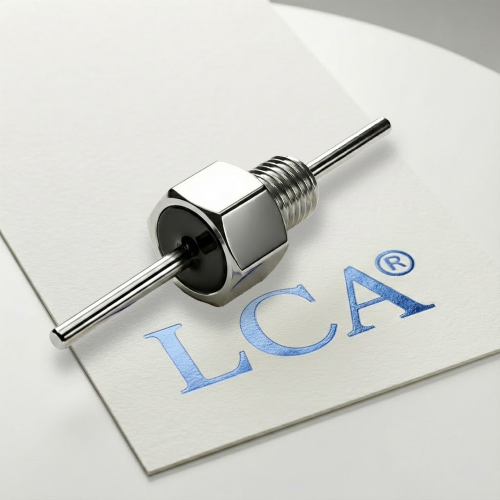
A threaded mount EMI filter — also referred to as a threaded feedthrough filter — uses a threaded body to mount through a panel hole and is secured with a nut and washer. The conductor passes through the component body, which simultaneously carries current and provides the chassis ground bond through the mechanical contact between the filter’s metal body and the panel wall.
The term “screw type” describes the installation method, not the internal electrical circuit. Threaded mount emi filters are available with C-type, L-C, T, and Pi internal networks, covering a range of common-mode and differential-mode suppression needs. Electrical performance is determined by the internal topology and capacitance value, not by the fact that it mounts with a nut and thread.
Threaded mount filters are widely used in industrial control cabinets, VFD and servo drive enclosures, CNC machine tool panels, and other applications where high current capacity, field serviceability, and robust mechanical installation are priorities.
What Is a Solder-In EMI Filter?
A solder-in EMI filter mounts by soldering its body or eyelet directly into a hole in the chassis or panel wall. The solder joint provides both mechanical retention and the electrical ground bond to the chassis. Like screw-type filters, the internal network can be C-type, L-C, T, or Pi — the mounting method and the electrical topology are independent choices.
Solder-in filters are a permanent installation. They are well suited to compact enclosures where space for a nut and washer is not available, to applications requiring a low-profile chassis entry, and to production environments where the filter installation can be integrated into an existing soldering process. They are commonly applied on single-conductor signal lines, lower-current power entries, and instrument or communications equipment panels.
Head-to-Head Comparison
Installation Process and Tooling
Threaded mount installation requires a panel hole, a nut, a washer, and a torque tool. The process is mechanical and does not require soldering expertise or process control for thermal management. It is well suited to field installation and can be performed with standard hand tools.
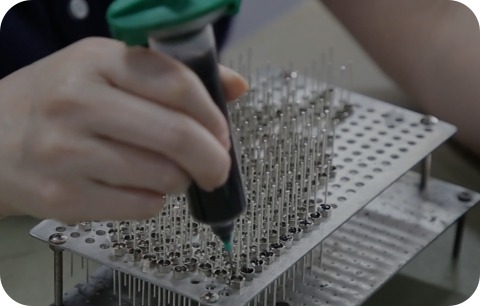
Solder-in installation requires a precisely dimensioned panel hole, the correct solder alloy, controlled heating, and thermal management to protect the internal capacitor element from thermal shock.
Grounding Quality and EMI Performance
Both types can achieve effective chassis grounding. For threaded mount filters, grounding quality depends on correct torque, clean metal-to-metal contact at the panel surface (free of paint, anodizing, or oxidation), and appropriate washer stack-up. For solder-in filters, grounding quality depends on full solder wetting around the filter body-to-chassis interface, correct alloy selection, and a properly dimensioned and prepared hole.
Neither type is inherently superior in EMI performance. In practice, threaded mount installation tends to produce more consistent grounding across a production run because the process is less sensitive to operator skill and thermal variation. Solder-in grounding quality is more dependent on process control and chassis surface preparation.
Mechanical Security and Vibration Resistance
A correctly torqued threaded mount feedthrough capacitor provides reliable mechanical retention under vibration and is straightforward to verify — torque values are measurable and repeatable.
Solder joints can also perform well under vibration when properly executed, but are more susceptible to fatigue under repeated thermal or mechanical cycling over time.
Field Serviceability and Rework Risk
This is where the two types diverge most clearly. Threaded mount feedthrough capacitors are field-replaceable. Removing and replacing a screw-type filter requires only standard hand tools and takes minutes. This matters for equipment that will be serviced in the field, or for designs where the filter specification may need to change after installation.
Solder-in filters are intended to be permanent. Rework is possible following IPC-7711 guidelines — controlled iron temperature and dwell time — but it carries real risks: repeated heating cycles can damage the internal MLCC capacitor element, and the chassis hole may require re-finishing after desoldering. Rework should be treated as an exception, not a routine maintenance operation. If the application requires periodic filter replacement or the possibility of specification changes after installation, screw-type is the more practical choice.
Production Process Compatibility
In high-volume PCB-centric manufacturing, solder-in filters can be integrated into wave or selective soldering processes alongside other through-hole components — provided thermal limits are strictly observed. This avoids a separate mechanical assembly step.
Threaded mount filters require a dedicated mechanical assembly operation and are not compatible with automated PCB soldering lines. For production environments where minimizing assembly steps is a priority, solder-in may reduce process complexity. For environments where production skill levels vary or process control for soldering is difficult to maintain, screw-type may reduce defect risk.
Summary and Quick-Reference Checklist
The choice between screw-type and solder-in EMI filters is ultimately determined by four factors: the current and phase requirements of the application, the production process available, whether field serviceability is required, and the physical constraints of the enclosure.
Threaded mount filters are the more flexible choice for high-current, high-vibration, and field-serviceable applications. Solder-in filters are appropriate where a compact, permanent installation is needed and where a controlled soldering process is available.
Neither type is universally superior. The internal electrical topology —not the mounting method — determines attenuation performance. Installation quality determines whether that performance is actually achieved.
Before finalizing your filter selection, confirm:
- Current and voltage ratings match the application, including derating margin
- Phase configuration is correct (single-phase or three-phase)
- Internal topology (C, L-C, T, Pi) matches the noise mode and frequency profile
- For solder-in: hole tolerance, solder alloy, and thermal process documented and validated
- For screw-type: panel surface prepared, torque specification confirmed
- Field serviceability requirement assessed and matched to mounting type
- Production process compatibility confirmed (wave solder vs. mechanical assembly)
- Certification marks verified by exact part number (not assumed by product family)
- RoHS / REACH compliance documentation obtained
Frequently Asked Questions
Q: Is the EMI filtering performance of a threaded mount filter better than a solder-in filter?
Not inherently. Both types can achieve comparable attenuation when the internal topology, capacitance value, and installation quality are equivalent. The mounting style affects how easily a low-impedance ground path can be established, but a well-installed solder-in filter can outperform a poorly installed threaded mount filter of the same specification. Internal circuit design and installation quality are the primary performance determinants.
Q: Can a screw-type filter be installed in the same panel hole as a solder-in filter?
No. The two types have different body geometries and hole requirements. Screw-type filters require a panel hole dimensioned for the thread and nut; solder-in filters require a precision clearance hole for the eyelet or body. Holes must be designed specifically for the intended filter type.
Q: Which type is better for high-vibration applications?
A correctly torqued threaded mount filter provides more predictable mechanical retention under sustained vibration. This retention is also more verifiable than that of a solder joint. However, both types can perform adequately when properly installed. Before assuming a filter type is suitable for a demanding mechanical environment, verify its vibration and shock ratings. This information must be obtained from the specific product’s datasheet.
Q: If a filter fails in the field, which type is easier to replace?
Threaded mount filters are field-replaceable without soldering equipment or specialized tools. Solder-in filters require controlled desoldering, which risks thermal damage to the replacement component and the chassis. Therefore, this process should be performed by trained personnel in ESD-controlled conditions.
Q: What if neither type fits my application?
Press-in feedthrough filters offer a third mounting method requiring neither solder nor threaded hardware. If neither screw-type nor solder-in is a clean fit, consult the manufacturer’s application engineering team. Be sure to provide your specific enclosure and production constraints.
Need Help Choosing Between Threaded Mount and Solder-In EMI Filters?
Every application is different — and so is every EMI challenge.
LCA’s engineering team can help you evaluate your installation requirements, grounding needs, and vibration environment. They will then recommend the right filter type based on your serviceability expectations for your industrial application.
Contact LCA today for one-to-one technical support and customized EMI suppression recommendations.