EMI filters that perform well at low frequencies often fail to deliver their rated attenuation in high-frequency systems. The insertion loss curve drops. Conducted emissions remain above the limit line. The filter that worked in a previous design provides no measurable improvement in the new one. These are not component defects — they are predictable consequences of how passive filter behavior changes when switching frequencies, clock rates, or noise spectra extend into the MHz range and beyond.
This article identifies six categories of high-frequency EMI filtering failure, explains the root cause of each, and provides engineering-level guidance on how to address them.
Why High-Frequency EMI Is Different
At low frequencies, a capacitor behaves as a capacitor and an inductor behaves as an inductor. The lumped-circuit model holds. Filter performance is predictable from component values and the circuit topology.
Above a few tens of MHz, this assumption breaks down. Parasitic elements — the equivalent series inductance (ESL) of capacitors, the self-capacitance of inductors, the inductance of PCB vias and traces, the capacitive coupling between adjacent conductors — become comparable in impedance to the intended filter elements. At these frequencies, the filter’s actual behavior is determined as much by its physical implementation as by its schematic.
Two transitions are particularly significant. First, every capacitor has a self-resonant frequency (SRF) above which it behaves inductively — its shunt impedance rises rather than falls. Second, every inductor has a self-resonant frequency above which its own parasitic capacitance provides a low-impedance bypass, reducing the series impedance the inductor was supposed to present. Both transitions reduce the filter’s net insertion loss, often sharply, at frequencies that may be well within the noise spectrum of the system being filtered.
Additionally, faster switching edges in SiC- and GaN-based power converters, high-speed digital interfaces, and modern motor drives generate harmonic content that extends significantly higher in frequency than older designs. The noise the filter must suppress has moved up; the filter’s effective range has a ceiling that did not change.
Challenge 1 — Component Parasitics Degrade Filter Performance
ESL Turns Capacitors Inductive Above SRF
A capacitor placed as a shunt element to chassis ground only attenuates noise at frequencies where it presents a low impedance to ground. Above its SRF, its impedance rises with frequency — the opposite of the intended behavior. The filter continues to appear in the schematic as a capacitor, but electrically it is behaving as an inductor.
This is the most common and most underestimated failure mode in high-frequency EMI filter design. Selecting a capacitor without confirming that its SRF is above the highest frequency of concern is selecting a component that cannot perform the intended function in that frequency range.
Solutions
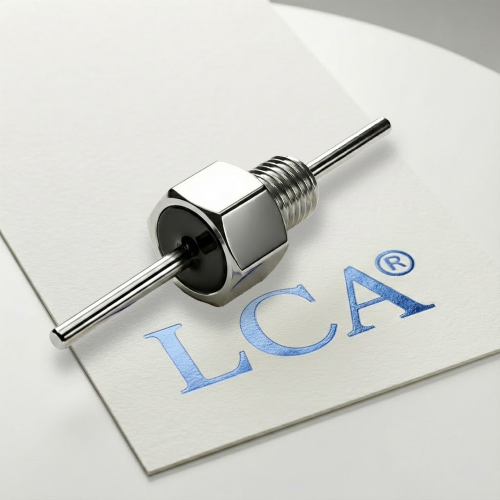
For capacitive shunt elements, the primary solution is component architecture, not value. Feedthrough and three-terminal capacitors route the signal conductor through the capacitor body, which virtually eliminates the series lead inductance in the noise shunt path. This extends effective capacitive filtering to frequencies well above the SRF of conventional two-terminal capacitors of the same nominal value. For applications where the noise frequency exceeds the SRF of available SMD or leaded capacitors, feedthrough-style components are the most direct substitution.
Challenge 2 — Impedance Mismatch Reduces Real-World Insertion Loss
Why Datasheet Insertion Loss Differs From In-Circuit Performance
Published insertion loss curves for EMI filters are measured in standardized test fixtures, typically with 50Ω source and load impedances. Real-world power line and signal line impedances are rarely 50Ω and vary with frequency in ways that are difficult to characterize without measurement. The actual in-circuit insertion loss can be substantially different — higher or lower — from the datasheet curve depending on the impedance environment.
This is not a product defect. It is an inherent characteristic of how passive filter performance depends on the termination impedances. An engineer who specifies a filter based solely on the datasheet curve without accounting for the actual source and load impedance is likely to be surprised by the hardware results.
Solutions
Measure insertion loss in the actual circuit using a vector network analyzer (VNA) or conducted emissions scan with the filter installed. Do not substitute datasheet curves for in-circuit measurement when the impedance environment differs from the 50Ω test condition. For power line EMI filters, where source impedance is dominated by the LISN (line impedance stabilization network) during formal testing, confirm which impedance environment the datasheet figures correspond to before using them for design decisions.
Challenge 3 — PCB Layout Undermines Filter Isolation
Ground Return Path Inductance
A shunt capacitor’s effectiveness is limited by the total inductance of the path from its ground terminal to the chassis or board ground reference. This includes via inductance, trace length from the capacitor pad to the nearest via, and the impedance of the ground plane itself. Even a few nanohenries of parasitic inductance in this path — easily accumulated through a long trace or multiple vias in series — can substantially reduce attenuation at high frequencies.
This failure mode is rarely visible in simulation because standard schematic models do not include PCB parasitic inductance. A filter that passes simulation and fails in hardware almost always has this as a contributing cause.
Input-to-Output Trace Coupling
If traces on the noisy (input) side of the filter run parallel to, or in close proximity to, traces on the filtered (output) side, high-frequency noise couples directly from one side to the other through capacitive or inductive coupling — bypassing the filter entirely. Increasing the filter’s component-level performance does not address this. The only fix is physical separation of the two sides of the filter on the PCB.
Solutions
Keep the ground connection of shunt capacitors as short as possible. Place a ground via immediately adjacent to each filter capacitor — not shared with other components, and not routed through a long trace to reach the nearest ground plane pour. Maintain a continuous, uninterrupted ground plane beneath the filter. Route input and output side traces on opposite sides of the filter footprint, ideally separated by a ground guard trace or partition. For chassis-mount feedthrough filters, the panel wall itself provides the separation — board-level filters must replicate this isolation through layout discipline.
Challenge 4 — Noise Re-Radiation Inside the Enclosure
How Filtered Conductors Re-Couple to Unfiltered Ones
A filter at a panel entry point suppresses conducted noise on the conductors that pass through it. If those filtered conductors then run alongside unfiltered conductors inside the enclosure, near-field coupling transfers energy from the unfiltered conductors back onto the filtered ones. The filter has been bypassed not by a layout error on the PCB but by cable routing inside the shielded box.
Solutions
Inside shielded enclosures, route filtered and unfiltered cables separately. Where possible, use shielded cables or routing channels that maintain physical separation. For enclosures with multiple cable entry points, ensure that filtered entry points remain isolated from unfiltered ones inside the enclosure. Filtered connector assemblies — where the filter is integrated into the connector body — minimize the length of filtered conductor exposed to re-coupling risk.
Challenge 5 — Signal Integrity Trade-offs on High-Speed Lines
EMI filter capacitance effectively suppresses noise on power lines. Yet it can degrade signal integrity on high-speed data lines. A shunt capacitor adds load capacitance that slows signal edges, reduces bandwidth, and introduces insertion loss within the signal passband. On differential signal pairs, adding a shunt capacitor to each line for common-mode suppression also attenuates the differential signal if the capacitance is too large.
Solutions
For high-speed digital signal lines, select filter components with the minimum capacitance necessary to provide the required attenuation at the noise frequency — not the maximum available. Feedthrough capacitors with small capacitance values (pF range) may provide adequate suppression at high noise frequencies without materially loading the signal. For differential pairs, a common-mode choke provides common-mode noise suppression without attenuating the differential signal, provided the common-mode choke’s frequency range covers the noise frequencies of concern. Confirm that the choke’s differential-mode insertion loss is within the signal’s tolerance before specifying it.
Challenge 6 — Measurement and Verification at High Frequency
Why Standard Scans Miss High-Frequency Problems
Formal conducted emissions testing under CISPR standards covers the range up to 30 MHz for many equipment categories. Problems above 30 MHz — which become radiated emissions concerns rather than conducted — may not be identified until radiated emissions testing, which is typically later in the development cycle and more expensive to diagnose and fix.
Solutions
A vector network analyzer (VNA) with an appropriate two-port fixture can measure the insertion loss of an installed filter from well below the CISPR conducted band up to hundreds of MHz or beyond, depending on the instrument range. This provides direct evidence of whether the filter’s attenuation curve behaves as expected in-circuit, or whether parasitic effects are causing the insertion loss to collapse above a certain frequency.
Near-field probes combined with a spectrum analyzer allow identification of specific coupling paths on the PCB. This is useful for locating where noise is bypassing a filter. The bypass occurs through layout-induced coupling rather than through the filter’s attenuation performance.
Pre-compliance radiated emissions scans, performed before formal testing, can identify problems above 30 MHz. These issues typically originate from high-frequency conducted noise that is re-radiated by cables or board structures.
Conclusion
High-frequency filter failures come from predictable causes: parasitic inductance, impedance mismatch, and poor layout. Success requires verifying SRF, using feedthrough capacitors, minimizing ground inductance, and separating input from output.
Based on LCA’s experience, following these practices helps achieve rated performance at high frequencies and simplifies compliance testing.
Summary Checklist
Before and after installing an EMI filter in a high-frequency system, confirm:
- SRF of all shunt capacitors verified to be above the highest noise frequency of concern
- Feedthrough or three-terminal capacitors used where SRF of standard capacitors is insufficient
- Ground via placed immediately adjacent to each shunt capacitor — no shared vias
- Ground plane continuous and uninterrupted beneath the filter area
- Input and output side traces physically separated on the PCB
- No thermal relief on ground connections of filter components
- Filtered and unfiltered cable routes separated inside the enclosure
- Insertion loss verified by in-circuit measurement, not only from datasheet
- Measurement method documented (VNA S21, conducted emissions scan, near-field probe)
- System-level EMC testing planned — component and layout improvements alone do not substitute for compliance testing in the final product configuration
Frequently Asked Questions
Q: Why does my EMI filter work at low frequencies but stop attenuating above ~100 MHz? Above the SRF of the filter’s shunt capacitors, those components transition from capacitive to inductive behavior — their shunt impedance rises rather than falls, reducing attenuation. Simultaneously, the series inductors in the filter may be bypassed by their own parasitic self-capacitance.
Q: I replaced my filter capacitor with a higher-value component and performance got worse at high frequency. Why? Higher capacitance lowers the SRF of the component. If the replacement capacitor’s SRF is now below the noise frequency of concern, the component is operating in its inductive region and providing less attenuation than the smaller part did. For high-frequency applications, SRF takes priority over capacitance value in the selection process.
Q: My filter passes simulation but fails in hardware. What should I check first? Standard SPICE models for EMI filters typically omit PCB parasitic inductance — via inductance, trace inductance, and ground plane impedance. Hardware failures after simulation success almost always involve ground return path inductance.
They can also result from input-to-output coupling in the PCB layout. In addition, the in-circuit impedance may differ significantly from the 50Ω simulation model. Check all three before modifying component values.
Q: Does improving high-frequency filter performance help with radiated emissions? It can, but indirectly. High-frequency conducted noise can drive cable and PCB structures as unintentional antennas, contributing to radiated emissions. Reducing conducted noise at its source or at panel entry points reduces the available drive current. However, radiated emissions compliance depends on additional factors including enclosure shielding, cable routing, and board layout. Filter improvements are one input to the radiated emissions outcome, not a guarantee of compliance.
Need Help Solving High-Frequency EMI Filtering Challenges?
Every high-frequency system is different — and so is every EMI failure mode.
LCA’s engineering team can help you diagnose SRF limitations, PCB parasitic effects, impedance mismatch, and coupling issues. They will then assess your system needs. Finally, they will recommend the right feedthrough capacitor or EMI filter solution for your MHz-range system.
Contact LCA today for one-to-one technical support and customized high-frequency EMI suppression recommendations.