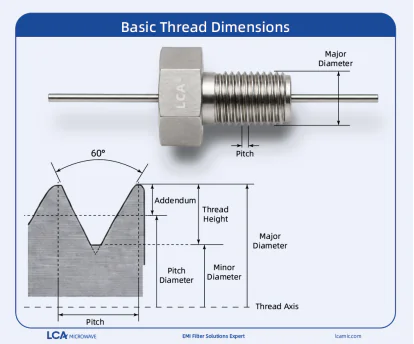
Introduction
Quick Answer: The Unified Thread Standard (UTS) is one of the most widely used screw thread systems in the world for inch-based fasteners and threaded components.
The Unified Thread Standard (UTS) is one of the most widely used screw thread systems in the world for inch-based fasteners and threaded components. It establishes standardized dimensions, thread forms, tolerance classes, and designation methods that allow threaded products manufactured by different companies to fit together reliably.
Today, UTS is used extensively across industries including industrial equipment, aerospace, defense, automotive, electronics, telecommunications, and EMI shielding products such as threaded feedthrough filters.
Quick Definition
The Unified Thread Standard (UTS) is the standard inch screw thread system used primarily in the United States and Canada. It defines thread geometry, thread series, tolerance classes, and designation rules for Unified threads including UNC, UNF, UNEF, and UNS.
What Is the Unified Thread Standard?
The Unified Thread Standard is a standardized system for inch-based screw threads that ensures compatibility between externally threaded and internally threaded components.
Rather than describing a single thread type, UTS defines an entire family of thread standards, including:
- Unified National Coarse (UNC)
- Unified National Fine (UNF)
- Unified National Extra Fine (UNEF)
- Unified National Special (UNS)
It also specifies:
- Thread dimensions
- Thread angle
- Pitch
- Tolerances
- Thread classes
- Designation methods
By following a common standard, manufacturers around the world can produce interchangeable threaded products without requiring custom machining.
History & Development
Before the Unified Thread Standard was introduced, different countries used incompatible inch thread systems, making international manufacturing and equipment main
To improve interchangeability, the United States, Canada, and the United Kingdom jointly developed the Unified Thread Standard in the mid-20th century. The system later became widely adopted throughout North America and remains the foundation for many inch-based threaded products today.
The current standard is governed primarily by ASME B1.1, which specifies dimensions, tolerances, and thread classes for Unified inch screw threads.
Key Characteristics
The Unified Thread Standard has several defining features that distinguish it from other thread systems.
| Characteristic | Description |
| Measurement System | Inch |
| Standard Thread Angle | 60° |
| Common Thread Series | UNC, UNF, UNEF, UNS |
| Thread Pitch | Threads Per Inch (TPI) |
| Standard | ASME B1.1 |
| Typical Thread Classes | 1A, 1B, 2A, 2B, 3A, 3B |
Unified Thread Series
UTS includes several standardized thread series designed for different engineering requirements.
UNC (Unified National Coarse)
Designed for general-purpose fastening with deeper thread profiles and fewer threads per inch. Suitable for softer materials and applications requiring fast assembly.
UNF (Unified National Fine)
Uses a finer thread pitch than UNC, providing greater clamping force and improved vibration resistance.
UNEF (Unified National Extra Fine)
Features very fine threads for thin-wall components, precision assemblies, and specialized engineering applications.
UNS (Unified National Special)
Covers non-standard pitch combinations that are not included within the standard UNC, UNF, or UNEF series.
Understanding Thread Designations
A Unified thread designation typically includes:
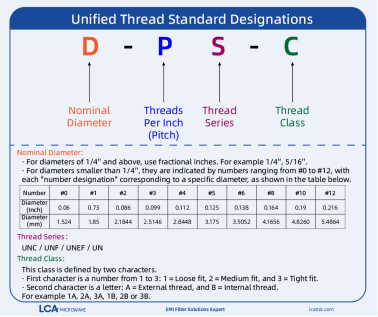
D – P S – C
Nominal Diameter – Threads Per Inch Thread Series – Thread Class
Nominal Diameter:
- For diameters of 1/4″ and above, use fractional inches. For example 1/4″, 5/16″.
- For diameters smaller than 1/4″, they are indicated by numbers ranging from #0 to #12, with each “number designation” corresponding to a specific diameter, as shown in the table below.
Diameter Number | #0 | #1 | #2 | #3 | #4 | #5 | #6 | #8 | #10 | #12 |
| Diameter (Inch) | 0.06 | 0.073 | 0.086 | 0.099 | 0.112 | 0.125 | 0.138 | 0.164 | 0.19 | 0.216 |
| Diameter (mm) | 1.524 | 1.8542 | 2.1844 | 2.5146 | 2.8448 | 3.175 | 3.5052 | 4.1656 | 4.8260 | 5.4864 |
Pitch:
The pitch is given in Threads Per Inch (TPI).
Thread Series:
UNC / UNF / UNEF / UNS
Thread Class:
This class is defined by two characters. For example 1A, 2A, 3A, 1B, 2B or 3B.
- First character is a number from 1 to 3: 1 = Loose fit, 2 = Medium fit, and 3 = Tight fit.
- Second character is a letter: A = External thread, and B = Internal thread.
For example:
#4-40 UNC-2A
Meaning:
- #4= Nominal thread size
- 40= Threads Per Inch (TPI)
- UNC= Unified National Coarse
- 2A= External thread tolerance class
This standardized format allows engineers and manufacturers to identify thread specifications quickly and accurately.
Advantages of the Unified Thread Standard
UTS offers numerous engineering benefits:
- Excellent interchangeability
- Well-established international standard
- Extensive range of standard sizes
- Consistent manufacturing tolerances
- Widely available tooling and gauges
- Suitable for both standard and precision applications
These advantages make UTS one of the most widely used inch thread systems worldwide.
Limitations
Although UTS is highly versatile, it may not be the best choice for every application.
Potential limitations include:
- Uses inch dimensions rather than metric units
- Not interchangeable with ISO Metric threads
- May require specialized tooling in regions where metric standards dominate
- Certain specialized applications may require proprietary thread forms
Selecting the appropriate thread standard should always consider regional practices, industry requirements, and compatibility with existing equipment.
Typical Applications
The Unified Thread Standard is widely used across many industries.
Common applications include:
- Industrial machinery
- Aerospace components
- Military equipment
- Telecommunications equipment
- Medical devices
- Electronic enclosures
- Precision instruments
- Threaded feedthrough filters
- EMI shielding products
- RF connectors
For manufacturers of threaded electronic components, such as feedthrough filters, UTS ensures compatibility with standard mounting hardware and panel designs.
UTS vs ISO Metric Threads
Although both systems define standardized screw threads, there are important differences.
| Unified Thread Standard | ISO Metric Thread |
| Inch-based dimensions | Metric dimensions |
| Pitch expressed as TPI | Pitch expressed in millimeters |
| ASME B1.1 | ISO 68 / ISO 261 / ISO 965 |
| UNC / UNF / UNEF | M Series |
| Primarily North America | Global industrial standard |
Neither system is directly interchangeable, even when nominal sizes appear similar.
Related Thread Standards
Within the Unified Thread Standard, the most common thread series include:
- UNC Threads
- UNF Threads
- UNEF Threads
- UNS Threads
Each series is optimized for different engineering requirements and should be selected based on strength, assembly conditions, material, and application.
Unified Inch Threads Dimensions Charts
UNC Series Basic Dimensions chart
Click Thread Link to check more data for each thread.
| Thread | Threads per inch (TPI) | Basic Major Diameter | Basic Minor Diameter | Thread Height | |||
| (in) | (mm) | (in) | (mm) | (in) | (mm) | ||
| #1 – 64 UNC | 64 | 0.073 | 1.854 | 0.0544 | 1.382 | 0.0085 | 0.216 |
| #2 – 56 UNC | 56 | 0.086 | 2.184 | 0.0647 | 1.643 | 0.0097 | 0.246 |
| #3 – 48 UNC | 48 | 0.099 | 2.515 | 0.0742 | 1.885 | 0.0113 | 0.287 |
| #4 – 40 UNC | 40 | 0.112 | 2.845 | 0.0822 | 2.088 | 0.0135 | 0.343 |
| #5 – 40 UNC | 40 | 0.125 | 3.175 | 0.0952 | 2.418 | 0.0135 | 0.343 |
| #6 – 32 UNC | 32 | 0.138 | 3.505 | 0.1008 | 2.56 | 0.0169 | 0.429 |
| #8 – 32 UNC | 32 | 0.164 | 4.166 | 0.1268 | 3.221 | 0.0169 | 0.429 |
| #10 – 24 UNC | 24 | 0.19 | 4.826 | 0.1404 | 3.566 | 0.0226 | 0.574 |
| #12 – 24 UNC | 24 | 0.216 | 5.486 | 0.1664 | 4.227 | 0.0226 | 0.574 |
| 1/4 – 20 UNC | 20 | 0.25 | 6.35 | 0.1905 | 4.839 | 0.0271 | 0.688 |
| 5/16 – 18 UNC | 18 | 0.313 | 7.938 | 0.2463 | 6.256 | 0.0301 | 0.765 |
| 3/8 – 16 UNC | 16 | 0.375 | 9.525 | 0.3006 | 7.635 | 0.0338 | 0.859 |
| 7/16 – 14 UNC | 14 | 0.438 | 11.112 | 0.3524 | 8.951 | 0.0387 | 0.983 |
| 1/2 – 13 UNC | 13 | 0.5 | 12.7 | 0.4084 | 10.373 | 0.0416 | 1.057 |
| 9/16 – 12 UNC | 12 | 0.563 | 14.288 | 0.4633 | 11.768 | 0.0451 | 1.146 |
| 5/8 – 11 UNC | 11 | 0.625 | 15.875 | 0.5167 | 13.124 | 0.0492 | 1.25 |
| 3/4 – 10 UNC | 10 | 0.75 | 19.05 | 0.6309 | 16.025 | 0.0541 | 1.374 |
| 7/8 – 9 UNC | 9 | 0.875 | 22.225 | 0.7427 | 18.865 | 0.0601 | 1.527 |
| 1 – 8 UNC | 8 | 1 | 25.4 | 0.8512 | 21.62 | 0.0677 | 1.72 |
| 1 1/8 – 7 UNC | 7 | 1.125 | 28.575 | 0.9549 | 24.254 | 0.0773 | 1.963 |
| 1 1/4 – 7 UNC | 7 | 1.25 | 31.75 | 1.0799 | 27.429 | 0.0773 | 1.963 |
| 1 3/8 – 6 UNC | 6 | 1.375 | 34.925 | 1.1766 | 29.886 | 0.0902 | 2.291 |
| 1 1/2 – 6 UNC | 6 | 1.5 | 38.1 | 1.3015 | 33.058 | 0.0902 | 2.291 |
| 1 3/4 – 5 UNC | 5 | 1.75 | 44.45 | 1.5118 | 38.4 | 0.1083 | 2.751 |
| 2 – 4.5 UNC | 4.5 | 2 | 50.8 | 1.7354 | 44.079 | 0.1203 | 3.056 |
| 2 1/4 – 4.5 UNC | 4.5 | 2.25 | 57.15 | 1.9523 | 49.588 | 0.1203 | 3.056 |
| 2 1/2 – 4 UNC | 4 | 2.5 | 63.5 | 2.2023 | 55.938 | 0.1353 | 3.437 |
| 2 3/4 – 4 UNC | 4 | 2.75 | 69.85 | 2.4523 | 62.288 | 0.1353 | 3.437 |
| 3 – 4 UNC | 4 | 3 | 76.2 | 2.7023 | 68.638 | 0.1353 | 3.437 |
| 3 1/4 – 4 UNC | 4 | 3.25 | 82.55 | 2.9523 | 74.988 | 0.1353 | 3.437 |
| 3 1/2 – 4 UNC | 4 | 3.5 | 88.9 | 3.2023 | 81.338 | 0.1353 | 3.437 |
| 3 3/4 – 4 UNC | 4 | 3.75 | 95.25 | 3.4523 | 87.688 | 0.1353 | 3.437 |
| 4 – 4 UNC | 4 | 4 | 101.6 | 3.7023 | 94.038 | 0.1353 | 3.437 |
UNF Series Basic Dimensions chart
Click Thread Link to check more data for each thread.
| Thread | Threads per inch (TPI) | Basic Major Diameter | Basic Minor Diameter | Thread Height | |||
| (in) | (mm) | (in) | (mm) | (in) | (mm) | ||
| #0 – 80 UNF | 80 | 0.06 | 1.524 | 0.0451 | 1.146 | 0.0068 | 0.173 |
| #1 – 72 UNF | 72 | 0.073 | 1.854 | 0.0565 | 1.435 | 0.0075 | 0.191 |
| #2 – 64 UNF | 64 | 0.086 | 2.184 | 0.0674 | 1.712 | 0.0085 | 0.216 |
| #3 – 56 UNF | 56 | 0.099 | 2.515 | 0.0777 | 1.974 | 0.0097 | 0.246 |
| #4 – 48 UNF | 48 | 0.112 | 2.845 | 0.0872 | 2.215 | 0.0113 | 0.287 |
| #5 – 44 UNF | 44 | 0.125 | 3.175 | 0.0979 | 2.487 | 0.0123 | 0.312 |
| #6 – 40 UNF | 40 | 0.138 | 3.505 | 0.1082 | 2.748 | 0.0135 | 0.343 |
| #8 – 36 UNF | 36 | 0.164 | 4.166 | 0.1309 | 3.325 | 0.015 | 0.381 |
| #10 – 32 UNF | 32 | 0.19 | 4.826 | 0.1528 | 3.881 | 0.0169 | 0.429 |
| #12 – 28 UNF | 28 | 0.216 | 5.486 | 0.1735 | 4.407 | 0.0193 | 0.49 |
| 1/4 – 28 UNF | 28 | 0.25 | 6.35 | 0.2075 | 5.271 | 0.0193 | 0.49 |
| 5/16 – 24 UNF | 24 | 0.313 | 7.938 | 0.2629 | 6.678 | 0.0226 | 0.574 |
| 3/8 – 24 UNF | 24 | 0.375 | 9.525 | 0.3254 | 8.265 | 0.0226 | 0.574 |
| 7/16 – 20 UNF | 20 | 0.438 | 11.112 | 0.378 | 9.601 | 0.0271 | 0.688 |
| 1/2 – 20 UNF | 20 | 0.5 | 12.7 | 0.4405 | 11.189 | 0.0271 | 0.688 |
| 9/16 – 18 UNF | 18 | 0.563 | 14.288 | 0.4963 | 12.606 | 0.0301 | 0.765 |
| 5/8 – 18 UNF | 18 | 0.625 | 15.875 | 0.5588 | 14.194 | 0.0301 | 0.765 |
| 3/4 – 16 UNF | 16 | 0.75 | 19.05 | 0.6756 | 17.16 | 0.0338 | 0.859 |
| 7/8 – 14 UNF | 14 | 0.875 | 22.225 | 0.7899 | 20.063 | 0.0387 | 0.983 |
| 1 – 12 UNF | 12 | 1 | 25.4 | 0.9008 | 22.88 | 0.0451 | 1.146 |
| 1 1/8 – 12 UNF | 12 | 1.125 | 28.575 | 1.0258 | 26.055 | 0.0451 | 1.146 |
| 1 1/4 – 12 UNF | 12 | 1.25 | 31.75 | 1.1508 | 29.23 | 0.0451 | 1.146 |
| 1 3/8 – 12 UNF | 12 | 1.375 | 34.925 | 1.2758 | 32.405 | 0.0451 | 1.146 |
| 1 1/2 – 12 UNF | 12 | 1.5 | 38.1 | 1.4008 | 35.58 | 0.0451 | 1.146 |
UNEF Series Basic Dimensions chart
Click Thread Link to check more data for each thread.
| Thread | Threads per inch (TPI) | Basic Major Diameter | Basic Minor Diameter | Thread Height | |||
| (in) | (mm) | (in) | (mm) | (in) | (mm) | ||
| #12 – 32 UNEF | 32 | 0.216 | 5.486 | 0.1788 | 4.542 | 0.0169 | 0.429 |
| 1/4 – 32 UNEF | 32 | 0.25 | 6.35 | 0.2128 | 5.405 | 0.0169 | 0.429 |
| 5/16 – 32 UNEF | 32 | 0.3125 | 7.938 | 0.2753 | 6.993 | 0.0169 | 0.429 |
| 3/8 – 32 UNEF | 32 | 0.375 | 9.525 | 0.3378 | 8.58 | 0.0169 | 0.429 |
| 7/16 – 28 UNEF | 28 | 0.4375 | 11.113 | 0.3949 | 10.03 | 0.0193 | 0.49 |
| 1/2 – 28 UNEF | 28 | 0.5 | 12.7 | 0.4574 | 11.618 | 0.0193 | 0.49 |
| 9/16 – 24 UNEF | 24 | 0.5625 | 14.288 | 0.5129 | 13.028 | 0.0226 | 0.574 |
| 5/8 – 24 UNEF | 24 | 0.625 | 15.875 | 0.5754 | 14.615 | 0.0226 | 0.574 |
| 11/16 – 24 UNEF | 24 | 0.6875 | 17.463 | 0.6379 | 16.203 | 0.0226 | 0.574 |
| 3/4 – 20 UNEF | 20 | 0.75 | 19.05 | 0.6905 | 17.539 | 0.0271 | 0.688 |
| 13/16 – 20 UNEF | 20 | 0.8125 | 20.638 | 0.753 | 19.126 | 0.0271 | 0.688 |
| 7/8 – 20 UNEF | 20 | 0.875 | 22.225 | 0.8155 | 20.714 | 0.0271 | 0.688 |
| 15/16 – 20 UNEF | 20 | 0.9375 | 23.813 | 0.878 | 22.301 | 0.0271 | 0.688 |
| 1 – 20 UNEF | 20 | 1 | 25.4 | 0.9405 | 23.889 | 0.0271 | 0.688 |
| 1 1/16 – 18 UNEF | 18 | 1.0625 | 26.988 | 0.9964 | 25.309 | 0.0301 | 0.765 |
| 1 1/8 – 18 UNEF | 18 | 1.125 | 28.575 | 1.0589 | 26.896 | 0.0301 | 0.765 |
| 1 3/16 – 18 UNEF | 18 | 1.1875 | 30.163 | 1.1214 | 28.484 | 0.0301 | 0.765 |
| 1 1/4 – 18 UNEF | 18 | 1.25 | 31.75 | 1.1839 | 30.071 | 0.0301 | 0.765 |
| 1 5/16 – 18 UNEF | 18 | 1.3125 | 33.338 | 1.2464 | 31.659 | 0.0301 | 0.765 |
| 1 3/8 – 18 UNEF | 18 | 1.375 | 34.925 | 1.3089 | 33.246 | 0.0301 | 0.765 |
| 1 7/16 – 18 UNEF | 18 | 1.4375 | 36.513 | 1.3714 | 34.834 | 0.0301 | 0.765 |
| 1 1/2 – 18 UNEF | 18 | 1.5 | 38.1 | 1.4339 | 36.421 | 0.0301 | 0.765 |
| 1 9/16 – 18 UNEF | 18 | 1.5625 | 39.688 | 1.4964 | 38.009 | 0.0301 | 0.765 |
| 1 5/8 – 18 UNEF | 18 | 1.625 | 41.275 | 1.5589 | 39.596 | 0.0301 | 0.765 |
| 1 11/16 – 18 UNEF | 18 | 1.6875 | 42.863 | 1.6214 | 41.184 | 0.0301 | 0.765 |
Frequently Asked Questions
- What does UTS stand for?
UTS stands for Unified Thread Standard, the primary inch-based screw thread system used in North America.
- Does UTS include UNC and UNF?
Yes. UNC, UNF, UNEF, and UNS are all thread series defined within the Unified Thread Standard.
- Is UTS compatible with ISO Metric threads?
No. The two systems use different dimensions, pitch specifications, and standards.
- What standard defines Unified Threads?
The principal engineering standard is ASME B1.1, which specifies thread dimensions, tolerances, and classes for Unified inch screw threads.
- Where is UTS commonly used?
UTS is widely used in industrial equipment, aerospace, defense, electronics, telecommunications, automotive systems, and threaded electronic components.
Engineering Support CTA: Selecting a threaded EMI filter or feedthrough capacitor? Share the thread standard and size, panel thickness, voltage/current, capacitance, and environmental requirements with LCA engineers. View Thread Mount Feedthrough Filters
Related Engineering Resources
Related LCA Products
Continue Exploring LCA Thread Engineering Center
Understanding the Unified Thread Standard is the first step toward selecting the correct thread for your application.
Explore our engineering resources to compare different Unified thread series, learn thread terminology, and access detailed thread specification pages, charts, and design guides. Whether you’re designing threaded EMI filters, selecting mounting hardware, or identifying an unknown thread, the LCA Thread Engineering Center provides practical engineering information to support your work.