Engineers designing systems for aerospace, military, space, and medical applications regularly encounter environments where a standard EMI filter simply cannot guarantee long-term protection. Thread-mount hermetically sealed feedthrough filters are a specific category of EMI/RFI suppression component built to address this gap. This article explains what they are, how they’re constructed, where they’re typically specified, and how to evaluate whether hermetic sealing is actually necessary for a given design.
▲View Related Products:L5/16-24UNF-2A-015
Introduction: Extreme Reliability Requirements
When standard filters are inadequate
Standard feedthrough filters — whether resin-sealed, potted, or conformally coated — provide EMI suppression and a reasonable degree of environmental protection for commercial and industrial use. However, resin and potting compounds are not fully impermeable. Over long periods, or under repeated thermal cycling, moisture and gases can migrate through these materials. In applications where any ingress is unacceptable, this level of protection is generally considered insufficient.
Applications requiring hermetic sealing
Hermetic sealing tends to become a requirement in a fairly specific set of conditions: vacuum or near-vacuum environments (where outgassing is a concern), cryogenic operation, sealed pressure vessels, and systems with multi-decade service-life expectations and no planned maintenance access. Aerospace, military, satellite, and certain implantable or life-support medical systems fall into this category most often.
Cost and complexity considerations
Hermetically sealed, thread-mount designs cost meaningfully more than standard feedthrough filters — largely due to the precision required in the glass-to-metal seal, the qualification testing involved, and generally lower production volumes. This makes it important to confirm hermetic sealing is actually required by the application before specifying it, rather than defaulting to it.
Understanding Feedthrough Filter Architecture
Basic feedthrough principle: direct enclosure penetration
A feedthrough filter is mounted so that it penetrates directly through the wall of a shielded enclosure, allowing a power or signal conductor to pass from outside to inside while the filter element suppresses conducted RF interference at the point of penetration. This differs from a filter mounted on a PCB or in-line on a cable, since the feedthrough filter itself forms part of the enclosure boundary.
Hermetic sealing: preventing environmental ingress
In a hermetically sealed version, the filter body is sealed using a glass-to-metal or ceramic seal rather than resin or epoxy. This is intended to prevent gas, moisture, or contaminants from passing through the filter itself, not just around its outer mounting interface.
Thread–mount design: mechanical installation
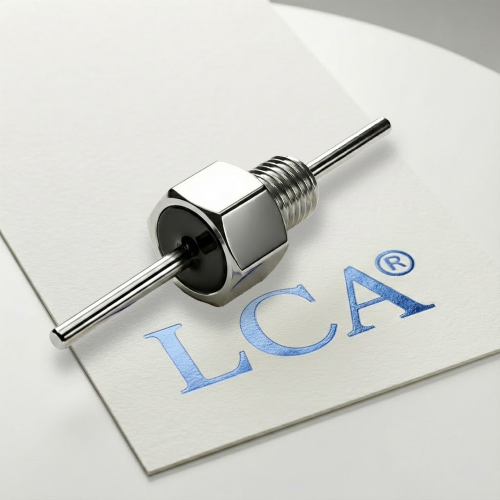
Thread-mount construction uses a threaded body that screws directly into a tapped hole in the enclosure wall. Per component-manufacturer guidance, the filter housing must make direct, unbroken metal-to-metal contact with the shielded wall — paint, anodization or surface coatings should be removed at the mating surface. Thread-mount installations typically use tapped holes or threaded bushings; press-fit mounting is generally avoided for hermetic thread-mount units, although solder-in hermetic feedthrough filters remain a valid alternative design. This low-impedance metal contact completes the RF shielding bond to the enclosure. Thread-mount hardware also enables controlled, verifiable installation torque during assembly.
Integration with pressure vessels and enclosures
Because the hermetic seal and mechanical mounting are both implemented within the same threaded interface, thread mount hermetic filters are widely used for wall penetrations on sealed enclosures and pressure vessels, without compromising the vessel’s pressure-holding or vacuum integrity.
Hermetic Sealing Construction and Materials
Glass-to-metal hermetic seals
Glass-to-metal seals are the most common hermetic sealing method referenced in supplier datasheets for this filter category. The seal is formed by fusing glass to the metal housing and center conductor under controlled conditions.
Thermal expansion matching and CTE compensation
Because the glass, metal housing, and dielectric expand and contract at different rates with temperature, the coefficients of thermal expansion of these materials need to be closely matched. A mismatch can introduce stress at the seal interface during thermal cycling, which is one of the more common causes of seal degradation over time.
Ceramic seals and their characteristics
Ceramic-based sealing is also used in some feedthrough filter designs as an alternative to glass, depending on the manufacturer and the specific electrical and mechanical requirements of the part.
Sealing integrity verification and testing
Hermeticity is typically verified using helium leak detection, with acceptance criteria defined by the governing specification. Under MIL-PRF-28861, for example, Class S filters are specified with a maximum leak rate of 1×10⁻⁷ atm·cm³/s.
Outgassing control for vacuum environments
For vacuum and space-facing applications, the materials used in the filter (dielectrics, adhesives, encapsulants) need to have low outgassing characteristics, since released volatile compounds can condense on nearby optics or sensitive surfaces. This is generally why hermetic, glass-sealed constructions are preferred over resin-sealed designs in vacuum applications.
Moisture barrier permeation control
A properly formed hermetic seal is intended to prevent moisture permeation over the operating life of the part, which is relevant for applications where the filter cannot be inspected or replaced after installation.
Military and Aerospace Standards Context
Several specifications are commonly referenced for this component category. It’s worth noting that not every thread-mount hermetic filter is qualified to every standard below — qualification should always be confirmed against the specific part’s documentation rather than assumed from the product category.
| Standard / Reference | Relevance to Thread–Mount Hermetic Feedthrough Filters |
| MIL-PRF-15733 | U.S. military performance specification covering feedthrough filter requirements, including hermeticity and electrical performance |
| MIL-PRF-28861 | U.S. military specification for EMI feedthrough filters; defines leak rate classes (e.g., Class S: ≤1×10⁻⁷ atm·cm³/s) |
| DSCC 84084 | Defense Supply Center Columbus capacitor specification; some feedthrough filters are listed under associated QPL documentation |
| IEC 60384-14 | Safety standard for fixed capacitors for EMI suppression, applicable to some feedthrough filter designs |
| IEC 60939-3 | Standard covering passive EMI filter units, including relevant safety and test requirements |
| MIL-STD-461 | Governs electromagnetic interference/compatibility requirements at the equipment level; feedthrough filters are one of the components used to help meet it, rather than being independently qualified to it |
For aerospace programs, requirements such as DO-160 (environmental conditions and test procedures for airborne equipment) are typically applied at the equipment or system level. Whether a specific filter’s construction supports compliance depends on the full assembly design, and should be confirmed with the supplier and, where applicable, third-party test data rather than inferred from the filter alone.
Electrical Performance Characteristics
Based on manufacturer datasheets for this filter category, typical parameter ranges include:
| Parameter | Typical Range (varies by part) |
| Capacitance | 5 pF to 1.4 µF |
| Working voltage | Up to 1000 VDC |
| Rated current | Up to 25 A |
| Attenuation | Up to ~70 dB at 100 MHz and 1 GHz |
| Effective frequency range | ~10 kHz to over 10 GHz (product-dependent) |
| Insulation resistance | ~10 GΩ or 1000 Ω·F (product-dependent) |
| Operating temperature | -55°C to +125°C |
| Leak rate (hermetic, Class S) | ≤1×10⁻⁷ atm·cm³/s per MIL-PRF-28861 |
These figures are drawn from published datasheets and vary between manufacturers and part numbers; they should not be treated as guaranteed values for any specific component without checking the applicable datasheet.
Mechanical Specifications
Common thread sizes referenced in supplier documentation include 1/4-28 UNF, 5/16-24, and M4, with thread engagement lengths around 0.187″ (4.76 mm) or 0.312″ (7.92 mm), and case diameters commonly around 0.375″, 0.410″, or 0.690″ depending on the part. Installation torque specifications are typically defined by the manufacturer — one supplier datasheet lists a maximum installation torque of 0.9 Nm (approximately 7.97 lbf·in). Exceeding the specified torque can damage the seal or thread, so torque control during assembly is generally recommended.
Comparing Thread–Mount Hermetic to Standard Feedthrough Filters
Standard feedthrough: environmental exposure risk
Standard (non-hermetic) feedthrough filters generally use resin or epoxy sealing. This is adequate for many industrial and commercial environments but is not typically rated for vacuum outgassing performance or multi-decade sealed-enclosure applications.
Resin-sealed alternatives: where they fit
Resin-sealed EMI filters are generally lower cost than hermetic equivalents and are described by at least one manufacturer as suitable for humid, dusty, mechanically stressed, or thermally cycled environments — without claiming vacuum or hermetic-level performance.
When standard feedthrough suffices
If the application does not involve vacuum, cryogenic exposure, sealed pressure vessels, or an extended maintenance-free service life, a standard or resin-sealed feedthrough filter may meet requirements at lower cost.
When hermetic sealing is warranted
Hermetic sealing is more clearly justified when the system must remain sealed for an extended period without inspection, operates in vacuum or near-vacuum conditions, or is governed by a specification (such as MIL-PRF-28861) that explicitly calls for a defined leak rate class.
Sourcing and Availability Considerations
Lead times for hermetically sealed feedthrough filters are generally longer than for standard commercial components, particularly for custom configurations, and can extend further when qualification testing or design-freeze documentation is required. Buyers should confirm with suppliers whether a given part is a catalog item or requires custom engineering, since this materially affects lead time and minimum order quantities. For long-life programs, it’s also worth asking suppliers directly about production continuity commitments, since component discontinuation is a recognized risk for specialized, low-volume parts.
Selection and Specification Framework
- Assess environmental requirements— vacuum, cryogenic exposure, humidity, thermal cycling, and expected service life.
- Determine whether hermetic sealing is actually necessary— based on the environment above, not by default.
- Identify applicable standards— MIL-PRF-15733, MIL-PRF-28861, IEC 60384-14/60939-3, or system-level requirements such as MIL-STD-461 or DO-160.
- Specify electrical and mechanical parameters— capacitance, voltage, current, attenuation at relevant frequencies, thread size, and torque rating.
- Verify supplier documentation— request leak rate test data, outgassing data (if applicable), and qualification records rather than relying on general product descriptions.
- Plan for qualification and lead time— build custom design review, testing, and longer procurement cycles into the program schedule.
Conclusion
Thread-mount hermetically sealed feedthrough filters combine feedthrough EMI filtering with a glass-to-metal or ceramic hermetic seal and a threaded mechanical interface, aimed at applications where environmental ingress cannot be tolerated over the system’s service life. They are not a universal upgrade over standard feedthrough filters — they address a specific set of environmental and reliability requirements, generally at higher cost and longer lead time. Selecting the right filter depends on matching the actual environmental and reliability requirements of the application against documented, verifiable specifications rather than assuming hermetic sealing is required by default.
Frequently Asked Questions
When is hermetic sealing actually necessary versus optional? It tends to be necessary for vacuum or space environments, cryogenic applications, sealed enclosures requiring strict moisture/contamination control, and systems with long, maintenance-free service life expectations. For many standard commercial applications, a resin-sealed or standard feedthrough filter may be sufficient.
What’s the practical difference between thread–mount hermetic and standard feedthrough filters? The main difference is the sealing method — glass-to-metal or ceramic hermetic seal versus resin or epoxy sealing — which affects environmental performance, qualification options, and typically cost and lead time.
How can I verify that a feedthrough filter is genuinely hermetically sealed? Request the manufacturer’s leak rate test data (commonly from helium leak detection), relevant specification compliance (e.g., MIL-PRF-28861 class), and, where applicable, outgassing test data. Documented test results are more reliable than a general product description.
Can a resin-sealed filter be substituted for a hermetic design? This depends entirely on why hermetic sealing was originally specified. If the requirement stems from vacuum, cryogenic, or long-term sealed-enclosure conditions, substitution introduces real risk. If hermetic sealing was specified without a clear environmental driver, a resin-sealed alternative may be worth evaluating.
What thread and mounting details should I confirm before specifying a part? Thread size (e.g., 1/4-28 UNF, 5/16-24, M4), thread engagement length, case diameter, and maximum installation torque — all of which vary by manufacturer and part number.
What standards commonly apply to this component category? MIL-PRF-15733 and MIL-PRF-28861 are the most frequently referenced U.S. military specifications for feedthrough filters; IEC 60384-14 and IEC 60939-3 are relevant international standards. Applicability should always be confirmed at the part-number level.
Next Steps
For engineers evaluating whether a thread-mount hermetically sealed feedthrough filter is appropriate for a specific program, reviewing supplier datasheets is a reasonable starting point. Leak-rate test data and applicable specifications — including MIL-PRF-15733, MIL-PRF-28861, and IEC 60384-14/60939-3 — should also be reviewed. These steps should be completed before finalizing a specification. Component engineers can also contact a supplier directly to confirm part-level qualification data and production availability for long-life programs.