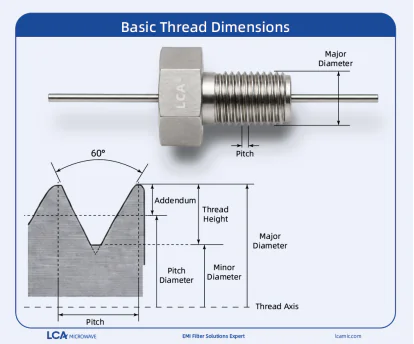
Quick Definition
Quick Answer: Threads Per Inch (TPI) is the number of thread crests counted within one inch of a threaded fastener or component.
Threads Per Inch (TPI) is the number of thread crests counted within one inch of a threaded fastener or component. It is commonly used to describe thread spacing in Unified thread systems, including UNC (Unified National Coarse) and UNF (Unified National Fine) threads.A higher TPI value means the threads are more closely spaced, while a lower TPI value indicates fewer and more widely spaced threads.
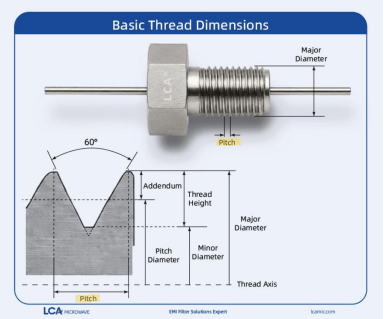
What Does Threads Per Inch (TPI) Mean?
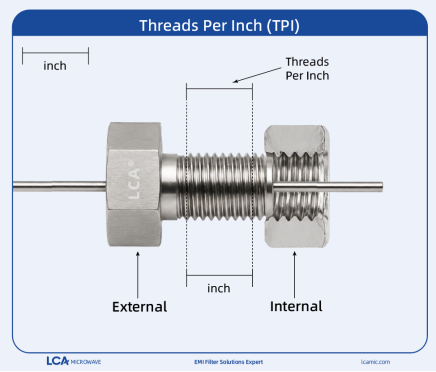
Threads Per Inch (TPI) describes the density of screw threads along the axial length of a threaded component.
Unlike metric thread systems, where thread spacing is specified directly by Thread Pitch in millimeters (mm), Unified thread systems typically identify thread spacing using TPI.
For example:
1/4-20 UNC thread
- Major diameter: 1/4 inch
- TPI: 20
- The screw has 20 threads within one inch
1/4-28 UNF thread
- Major diameter: 1/4 inch
- TPI: 28
- The screw has 28 threads within one inch
Although these two screws have the same nominal diameter, their thread spacing is different and they are not interchangeable
Why Is Threads Per Inch (TPI) Important?
Threads Per Inch is a critical parameter when selecting and matching threaded components.
The correct TPI ensures:
- Proper engagement between mating threads
- Reliable mechanical fastening
- Prevention of cross-threading
- Correct assembly performance
- Compatibility with existing components
Using a screw with an incorrect TPI may cause:
- Poor thread engagement
- Loose mechanical connection
- Thread damage
- Failure during assembly
When identifying an unknown threaded component, engineers usually measure:
- Major diameter
- Thread form
- Threads Per Inch (TPI) or thread pitch
before comparing the measurements with standard thread specifications.
How to Measure Threads Per Inch (TPI)
Method 1 – Thread Pitch Gauge
The most common and accurate method for identifying thread pitch.
Method 2 – Manual Measurement
Measure the distance across several adjacent threads and divide by the number of thread intervals for an approximate pitch.
Method 3 – Compare with Standard Thread Charts
Verify the measured value using ISO Metric or Unified thread specification charts.
Thread Pitch vs Threads Per Inch (TPI)
Although TPI and Thread Pitch both describe thread spacing, they use different measurement methods.
| Parameter | Threads Per Inch (TPI) | Thread Pitch |
| Definition | Number of threads within one inch | Distance between adjacent thread crests |
| Unit | Threads per inch | Millimeters (mm) |
| UNC / UNF Unified threads | ISO Metric threads | |
| Measurement | Count threads | Measure distance |
| Example | 20 TPI | 1.5 mm pitch |
The relationship between TPI and pitch is:
- Pitch = 1 ÷ TPI
For example:
- 20 TPI = 1 ÷ 20 = 0.05 inch pitch
Therefore, TPI and pitch describe the same physical feature from different measurement perspectives.
Frequently Asked Questions
- Is TPI the same as thread pitch?
No. TPI counts the number of threads per inch, while thread pitch measures the distance between adjacent threads. They describe the same thread spacing using different units.
- How do I calculate pitch from TPI?
For Unified threads:
Pitch = 1 ÷ TPI
The result is the thread spacing in inches.
- Can screws with the same diameter have different TPI?
Yes. A single nominal diameter may have multiple thread options, such as coarse and fine threads.
For example, a 1/4 inch screw may be available in both 20 TPI and 28 TPI versions.
- What happens if the TPI does not match?
Incorrect TPI prevents proper thread engagement and may result in cross-threading, poor fastening performance, or permanent damage to mating components.
- How is TPI used in engineering drawings?
Engineering drawings may specify thread dimensions using Unified thread designations such as: 1/4-20 UNC, 10-32 UNF, or 8-32 UNC
The number after the diameter indicates the TPI value.
Engineering Support CTA: Selecting a threaded EMI filter or feedthrough capacitor? Share the thread standard and size, panel thickness, voltage/current, capacitance, and environmental requirements with LCA engineers. View Thread Mount Feedthrough Filters