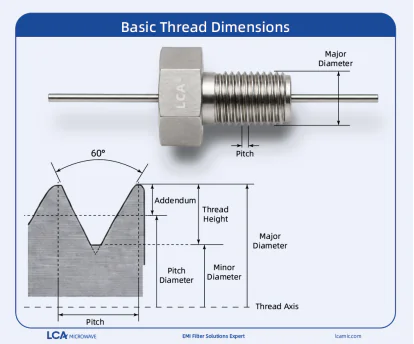
Quick Definition
Quick Answer: Thread Class defines the allowable manufacturing tolerance and fit between mating threads.
Thread Class defines the allowable manufacturing tolerance and fit between mating threads. It specifies how tightly an external thread and an internal thread fit together while ensuring proper assembly and interchangeability.
What Is Thread Class?
Thread Class is a standardized tolerance system used in Unified thread standards to control the fit between external and internal threads.
Rather than changing the thread size, Thread Class controls the amount of clearance between mating threads, affecting assembly, precision, and manufacturing requirements.
The most common Unified thread classes are:
- 2A– Standard external thread
- 2B– Standard internal thread
- 3A– Precision external thread
- 3B– Precision internal thread
Why Is Thread Class Important?
Thread Class helps balance manufacturing cost, assembly performance, and mechanical reliability.
Selecting the appropriate class ensures:
- Proper thread fit
- Reliable interchangeability
- Consistent manufacturing quality
- Appropriate clearance for assembly
- Compliance with engineering standards
Higher-precision thread classes generally require tighter manufacturing tolerances and more accurate inspection.
Common Thread Classes
| Thread Class | Description | Typical Applications |
| 1A / 1B | Loose fit | Quick assembly, rarely used |
| 2A | Standard external thread | General industrial applications |
| 2B | Standard internal thread | General-purpose threaded holes |
| 3A | Precision external thread | Aerospace, instrumentation |
| 3B | Precision internal thread | High-precision assemblies |
Thread Class vs Thread Size
Thread Class and Thread Size describe different characteristics.
- Thread Sizeidentifies the nominal dimensions of the thread.
- Thread Classspecifies the manufacturing tolerance and fit.
For example:
4-40 UNC-2A
- 4-40 UNC = Thread size
- 2A = External thread class
Frequently Asked Questions
- What is the difference between 2A and 2B?
2A is used for external threads, while 2B is used for internal threads.
- When should 3A and 3B be used?
They are commonly used in precision engineering applications requiring tighter tolerances and reduced clearance.
- Does Thread Class change the thread diameter?
No. It changes the allowable tolerance and fit, not the nominal thread size.
- Which Thread Class is most common?
Class 2A and 2B are the most widely used for general industrial applications.
Engineering Support CTA: Selecting a threaded EMI filter or feedthrough capacitor? Share the thread standard and size, panel thickness, voltage/current, capacitance, and environmental requirements with LCA engineers. View Thread Mount Feedthrough Filters