Introduction
When a specification says “hermetic,” it is often unclear what that means in practice, which environments justify it, and what evidence should accompany the part. The choice affects cost, lead time, and documentation, and it does not by itself determine filtering performance.
This article explains how hermetic miniature RF EMI filters are constructed, when resin sealing may not be sufficient, what tradeoffs apply, and what OEM engineers typically ask suppliers to document. The statements are general. Confirm all values against the manufacturer’s datasheet, test reports, and system-level EMC testing.
Quick Overview: Hermetic vs Resin-Sealed Filters
| Aspect | Hermetic (e.g., glass-to-metal) | Resin-sealed |
| Sealing approach | Glass- or ceramic-to-metal seal | Resin or epoxy fill |
| General tendency | Intended to limit gas and moisture ingress | Provides environmental protection; may be less suited to demanding conditions |
| Cost and lead time | Often higher or longer (quotation-dependent) | Often lower or shorter (quotation-dependent) |
| What to check | Leak test method, criteria, and part-specific record | Suitability for the stated environment |
These are general tendencies. Actual cost, size, and availability vary by series and supplier.
What Makes an EMI Filter “Hermetic”?
Glass-to-Metal Sealing in Miniature RF Filters
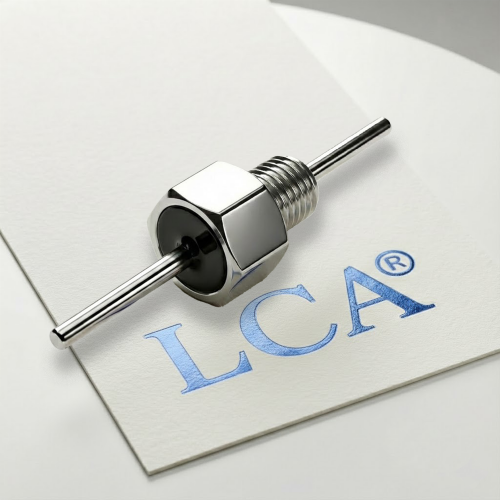
Hermetic filters typically use a glass-to-metal or ceramic-to-metal seal around the conductor and housing, combined with a low-ESL ceramic capacitor structure. The seal is intended to keep moisture and contaminants from entering the filter interior. Supplier literature describes these constructions for use in demanding environments, but the seal type alone does not define the performance level.
What Hermetic Sealing Does and Does Not Protect Against
Sealing addresses the filter’s internal environment: moisture, contamination, and similar ingress. It does not make the filter immune to all stresses. Mechanical damage from incorrect mounting torque, a poor ground connection, or operation beyond rated voltage, current, or temperature can still degrade or damage the part. Hermetic construction is also not a guarantee of long-term performance in every environment.
Leak Rate Testing: What to Ask About
Hermeticity is commonly verified by leak rate testing, often with helium leak detection. Supplier literature references leak rate limits and test practices, but these differ by product and specification. Rather than relying on a general claim, ask the supplier:
- Which test method is used
- What acceptance criterion applies to the part
- Whether testing is performed on every unit or by sampling
- Whether a part-specific test record is available
LCA has been developing ceramic EMI suppression components and low-pass filter solutions . Our product range includes feedthrough capacitors, glass-sealed feedthrough filters, miniature RF EMI filters, and customized EMI suppression solutions. For applications requiring hermetic sealing, the construction, electrical ratings, mounting interface, and applicable leak test requirements should be evaluated together to ensure that the selected component meets the program specifications.
Harsh Environment Factors to Define First
Define the environment from your own program specification. Do not assume that a typical range applies.
Moisture, Contamination and Chemical Exposure
Humidity, salt-laden atmospheres, solvents, and other chemicals can affect internal materials and terminations. List the actual exposures and any associated test requirements.
Low Pressure and Outgassing
Low-pressure or vacuum conditions can make outgassing from internal materials a concern. If your application involves such conditions, ask the supplier about the materials used and any relevant test evidence.
Temperature Range, Thermal Cycling, Vibration and Shock
Supplier literature cites a range of operating temperatures depending on the product, so the ranges are not interchangeable. Use your own specification, and ask which thermal cycling, vibration, and shock tests have been performed and under what conditions.
Need a Hermetic EMI Filter for Your Application?
When selecting a hermetic miniature RF EMI filter, sealing construction is only one part of the decision. Leak rate requirements, operating temperature, electrical ratings, mounting dimensions, and environmental conditions must also be considered.
For over 20 years, LCA has been developing ceramic EMI suppression components, glass-sealed feedthrough filters, and customized EMI filtering solutions for electronic equipment manufacturers.
If your application requires hermetic sealing or specific environmental performance, our team can review your requirements and discuss suitable product configurations.
Contact LCA for technical support, product documentation, or a customized quotation.
[Request Technical Support] | [Request a Quote]
When Resin Sealing May Not Be Sufficient
Environmental Conditions That Point Toward Hermetic Construction
Supplier literature indicates that resin sealing may not be sufficient where moisture, outgassing, low pressure, or chemical attack are concerns, and that hermetic glass-to-metal sealing may be needed in those cases. This is a general description, not a selection rule.
When Resin Sealing May Be Adequate
In less demanding conditions, such as many general industrial environments, resin sealing may be adequate and may offer cost or availability advantages. Whether it is adequate for your program depends on the environmental specification.
Whether hermetic sealing is required is a program decision. Confirm it with your engineering and quality teams.
Tradeoffs: Hermetic vs Resin-Sealed
Cost and Lead Time
Hermetic construction generally involves more specialized processes, so cost and lead time can differ from resin-sealed options. The size of the difference depends on the series and supplier, so confirm by quotation.
Size, Mounting and Current Handling
Package size, mounting style (for example solder-in or threaded), and current rating vary across both construction types. Supplier literature shows a range of ratings for hermetic filters, and these ranges overlap with other constructions. Compare ratings at your operating temperature rather than assuming an advantage for either type.
Electrical Performance Considerations
Sealing is a package property. It does not by itself improve insertion loss. Filtering performance is still determined by topology, capacitance, SRF, grounding, and installation. Do not select hermetic construction in the expectation that attenuation will be better.
Electrical Specifications Still Matter
Insertion Loss and SRF
Insertion loss is commonly expressed as 20·log₁₀(V_B / V_C), where V_B is the load voltage without the filter and V_C is the load voltage with it. Datasheets often reference MIL-STD-220, which uses a 50 Ω source and load. Your circuit may present different impedances, so performance can differ from the published curve. For RF paths, request S-parameter data where available.
Above the self-resonant frequency (SRF), insertion loss declines with frequency. Higher capacitance lowers the SRF, so a larger value is not automatically better. Confirm that the SRF sits above your highest frequency of concern.
Ratings and Derating
Current flow raises component temperature, so ambient temperature affects usable current. Inductive elements in multi-pole filters may require derating. Select voltage and current ratings with margin and follow the manufacturer’s guidance.
Grounding, Mounting and Torque
- Keep the ground path short and wide.
- Ensure the housing or flange contacts clean, bare metal, free of paint, oxidation, and contamination.
- Follow the datasheet for mounting torque, and avoid applying torque to the ceramic body.
- Separate input and output wiring, since coupling can let noise bypass the filter.
Materials, Plating and Compliance
Housing Material and Gold Plating
Housing material and plating affect corrosion behavior, solderability, and contact quality. Some miniature RF filters use metal housings with gold plating. Check these against your assembly process and program requirements.
RoHS/REACH and Tin-Lead Considerations
Material declarations may be required. Aerospace and defense programs may have lead-free or tin-lead preferences that differ from general commercial requirements, so confirm them against your program.
Standards References and What They Do and Do Not Prove
| Reference | General role | What to confirm with the supplier |
| MIL-STD-220 | Insertion loss measurement method | Test conditions behind the published curve |
| MIL-PRF-15733 | Military EMI filter specification | Whether the specific part is covered, with evidence |
| MIL-PRF-28861 | Military EMI/RFI filter specification | Whether the specific part is covered, and qualification status |
| MIL-STD-461 | Equipment-level EMI requirements | Equipment-level only; not a filter certification |
| DO-160 / ED-14 | Civil airborne equipment testing | Equipment-level only; not a filter certification |
| RoHS / REACH | Material restrictions | Declarations for the part number |
No single standard covers all hermetic miniature RF EMI filters. A statement that a product family relates to a specification is not the same as a qualification record for the exact part number. Verify the current revision and ask for supporting documents.
Common Mistakes When Specifying Hermetic Filters
- Treating “hermetic” as a universal guarantee.
- Leaving the leak test method and criterion undefined.
- Assuming every harsh environment requires hermetic construction.
- Expecting better insertion loss from sealing alone.
- Overlooking grounding, torque, and derating.
- Treating equipment-level standards as component certification.
- Deferring second-source and obsolescence checks.
Frequently Asked Questions
What does hermetic mean for an EMI filter?
It generally refers to a sealed construction, such as glass-to-metal, intended to limit gas and moisture ingress. The actual level depends on the supplier’s test method and acceptance criterion.
Are hermetic filters required for harsh environments?
Not necessarily. It depends on the environment and program requirements. Confirm with your engineering and quality teams.
When might resin sealing not be sufficient?
Supplier literature indicates it may fall short where moisture, outgassing, low pressure, or chemical attack are concerns. Evaluate against your specification.
Does hermetic sealing improve insertion loss?
Not by itself. Performance depends on topology, capacitance, SRF, grounding, and installation.
How is hermeticity verified?
Typically by leak rate testing. Ask for the test method, criterion, and a record for your part number.
What documents should purchasing request?
Insertion loss curves with test conditions, ratings and derating, environmental and leak test evidence, material declarations, and traceability records as required.
Are hermetic filters more expensive or slower to obtain?
They often involve more specialized processes, but cost and lead time depend on the series and supplier. Confirm by quotation.