M48 ×3 Thread Overview
When precision matters more than speed, M48 × 3 fine threads deliver superior performance. Unlike coarse alternatives, this metric fine thread configuration provides:
- Enhanced Positioning Accuracy– more engaged threads within the same mounting length
- Smoother Adjustment Resolution– Finer pitch enables micro-adjustments in optical and mechanical systems
- Reduced Vibration Loosening– Greater thread engagement increases resistance to self-loosening under dynamic loads
- Space-Efficient Design– Achieves higher clamping force without requiring additional axial length
Industries leveraging M48 × 3: precision optics, medical devices, instrumentation, aerospace components, and calibration equipment.
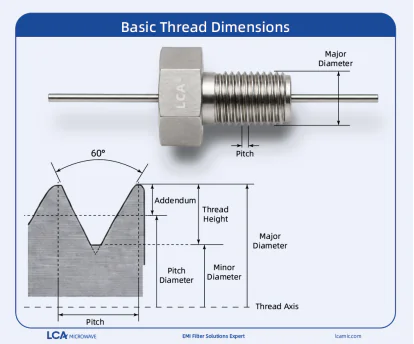
M48 × 3 Thread Dimensions
| Parameter | Specification | |
| Thread Standard | ISO Metric Threads | |
| Major Diameter | 48.0mm | 1.8898 in |
| Pitch | 3 mm | 0.1181 in |
| Pitch Diameter | 46.051 mm | 1.813 in |
| Minor Diameter | 47.752 mm | 1.7619 in |
| Thread Height | 1.624 mm | 0.0639 in |
| Addendum | 0.974 mm | 0.0383 in |
| Thread Angle | 60° | |
Understanding the M48 × 3 Designation
The designation identifies the basic geometry of the thread:
- M= ISO Metric Thread
- 48= Nominal major diameter of 48 mm
- 3= Thread pitch of 3 mm
The pitch should be stated when specifying the thread because the same nominal M48 diameter can be manufactured with different pitches. Writing M48 × 3 removes ambiguity during design, machining, and purchasing.
Characteristics of M48 × 3 Fine Thread
- Smaller pitch than the standard M48× 5 coarse thread.
- Finer axial adjustment and greater adjustment resolution.
- More engaged threads over the same threaded length.
- Useful where available axial space is limited.
- Suitable for precision mechanical assemblies and fine adjustment mechanisms.
M48 × 3 Thread Tolerance Classes
Thread tolerance classes define the permissible dimensional variation and determine how mating external and internal threads fit together. ISO metric fine threads, a complete tolerance designation combines a numerical tolerance grade with a tolerance-position letter.
Example: M48 × 3 – 6g
- 6 — Tolerance grade.
- g — Tolerance position for an external thread.
The corresponding internal thread is typically specified as M48 × 3 – 6H.
| Thread Type | Common Class | Typical Application |
| External Thread | 6g | General-purpose screws and bolts |
| Internal Thread | 6H | General-purpose tapped holes and nuts |
| External Thread | 4g6g | Precision mechanical assemblies |
| External Thread | 8g | Loose fit or coated fasteners |
| Internal Thread | 5H | Higher positioning accuracy |
When to Use M48 × 5 (Coarse) Instead
M48× 3 and M48 × 5 have the same nominal major diameter, but their pitches are different. The choice depends on the required assembly characteristics and application.
| Feature | M48 × 3 | M48 × 5 |
| Thread Type | Fine thread | Standard coarse thread |
| Pitch | 3 mm | 5 mm |
| Adjustment | More precise | Faster |
| Thread Engagement | More threads per length | Fewer threads per length |
| Assembly | Suitable for precision adjustment | Generally easier and faster |
| Typical Use | Precision assemblies and fine adjustment | General-purpose fastening |
Typical Applications
M48 × 3 fine threads can be used in applications where controlled adjustment, positioning accuracy, or compact threaded engagement is required. Examples include:
Optical instruments
- Precision measuring devices
- Fine adjustment mechanisms
- Precision mechanical assemblies
By comparison, M48×5 coarse threads are commonly selected for general-purpose fastening applications, including industrial equipment, enclosures, and control panels.
Frequently Asked Questions (FAQ)
Q1. Is M48 × 3 a standard thread?
Yes. M48 × 3 is a standardized ISO metric fine thread defined by ISO 965-1 and ISO 965-2. It is less common than M48 × 5 but fully recognized in international engineering standards and specifications.
Q2.What happens if I specify just “M48” on an engineering drawing?
Drawings specifying only “M48” default to M48 × 5 coarse thread. To ensure the fine-pitch version is used, explicitly write M48 ×3. This prevents costly manufacturing and procurement errors.
Q3: Can I substitute M48×3 with M48 × 5 in an existing assembly?
No. The different pitches produce incompatible thread geometries. Using M48 × 5 fasteners in M48 × 3 tapped holes will cross-thread and damage both components. Always match pitch specifications exactly.
Q4.What does 6g mean for an M48 ×3 thread?
6g is a commonly used tolerance designation for an external ISO metric thread, combining tolerance grade 6 with tolerance position g.
Q5.What is the typical internal-thread designation?
The corresponding internal thread is typically specified as M48 × 3 – 6H.
Q6. Can LCA provide EMI filters with M48 threads?
Yes. LCA supports customized mechanical designs involving metric and inch thread configurations.
Customization options include:
- Thread size
- Housing dimensions
- Electrical parameters
- Sealing structure
- Plating options
Engineering Support CTA: Selecting a threaded EMI filter or feedthrough capacitor? Share the thread standard and size, panel thickness, voltage/current, capacitance, and environmental requirements with LCA engineers. View Thread Mount Feedthrough Filters
Related Engineering Resources
- Unified Thread Standard
- UNC Threads
- UNF Threads
- UNEF Threads
- Metric Threads
- Metric Coarse Threads
- Metric Fine Threads
- #4-40 UNC Thread Dimensions
- 1/4-28 UNF Thread Dimensions
- 5/16-32 UNEF Thread Dimensions
- 5 Thread Dimensions
- M5 Thread Dimensions
- M4 Thread Dimensions
- M6 Thread Dimensions
- M7 Thread Dimensions
- M8 Thread Dimensions
- M9 Thread Dimensions
- M10 Thread Dimensions
- M11 Thread Dimensions
- M12 Thread Dimensions
- M14 Thread Dimensions
- M16 Thread Dimensions
- M18 Thread Dimensions
- M20Thread Dimensions
- M22 Thread Dimensions
- M24 Thread Dimensions
- M27 Thread Dimensions
- M30 Thread Dimensions
- M33 Thread Dimensions
- M36 Thread Dimensions
- M39 Thread Dimensions
- M42 Thread Dimensions
- M45 Thread Dimensions