Introduction
Quick Answer: Thread charts provide a quick reference for identifying common thread sizes, pitches, diameters, and other important dimensions.
Thread charts provide a quick reference for identifying common thread sizes, pitches, diameters, and other important dimensions.
The LCA Thread Charts library brings together commonly used metric and Unified thread data in easy-to-reference tables. Instead of searching through individual specifications, engineers, designers, purchasing professionals, and inspectors can use these charts to quickly compare thread sizes and locate the information they need.
The charts are organized by thread family, making it easier to find the appropriate reference for UNC, UNF, UNEF, Metric Coarse, and Metric Fine threads.
Browse Thread Charts
Choose a thread system below to access its dedicated dimensional chart.
UNC (Unified National Coarse) Thread Charts
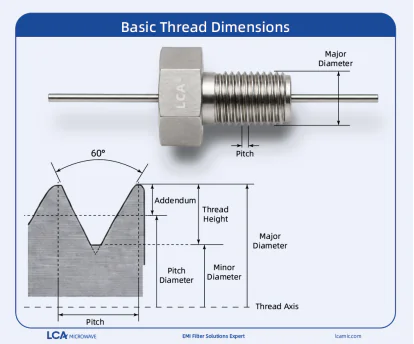
The UNC Thread Chart provides reference data for Unified National Coarse threads, including common thread designations, TPI, pitch, major diameter, pitch diameter, minor diameter, and other basic dimensions.
UNC threads are widely used for general-purpose mechanical fastening applications.
Related Guide:
UNF (Unified National Fine) Thread Charts
The UNF Thread Chart provides dimensional reference data for Unified National Fine threads, including thread designation, TPI, pitch, major diameter, pitch diameter, minor diameter, and other relevant dimensions.
UNF threads use a finer pitch than corresponding UNC sizes and are commonly used where finer adjustment, greater thread engagement, or other application-specific requirements are desired.
Related Guide:
UNEF (Unified National Extra Fine) Thread Charts
The UNEF Thread Chart provides reference data for Unified National Extra Fine threads, including thread designation, TPI, pitch, major diameter, pitch diameter, minor diameter, and other basic dimensions.
UNEF threads use a finer pitch than UNC and UNF threads and are generally used for specialized applications where an extra-fine thread is appropriate.
Related Guide:
Metric Coarse Thread Charts
The Metric Coarse Thread Chart provides dimensional reference data for standard ISO Metric coarse threads.
View Metric Coarse Thread Chart →
Related Guide:
Metric Fine Thread Charts
The Metric Fine Thread Chart provides reference data for ISO Metric fine threads and their corresponding dimensions.
Metric fine threads use a smaller pitch than the commonly used coarse thread for the same nominal diameter.
View Metric Fine Thread Chart →
Related Guide:
LCA Engineering Services
Selecting the right thread is only one aspect of successful product integration.
LCA provides engineering support throughout the development process, helping customers optimize both the mechanical and electrical performance of threaded EMI components.
Frequently Asked Questions
Q1: What is a thread chart?
A thread chart is a reference table that lists standardized thread sizes and their corresponding dimensions, such as pitch, TPI, major diameter, pitch diameter, and minor diameter.
Q2: What is the difference between a metric thread chart and a UNC thread chart?
Metric thread charts normally specify pitch in millimeters, while UNC charts specify thread pitch using Threads Per Inch (TPI). They also belong to different thread standard systems.
Q3: What is the difference between UNC and UNF thread charts?
UNC and UNF are both part of the Unified Thread Standard. UNC uses a coarser pitch, while UNF uses a finer pitch for corresponding nominal diameters.
Q4: What is the difference between Metric Coarse and Metric Fine?
For the same nominal diameter, a Metric Fine thread has a smaller pitch than the corresponding standard Metric Coarse thread.
Q5: Are the dimensions in a thread chart actual manufactured dimensions?
Not necessarily. Many chart values represent basic or theoretical dimensions defined by the applicable standard. Actual manufactured threads are produced within specified tolerance limits.
Q6: Where can I find the complete specifications of one thread size?
Click on the thread model to view the corresponding Thread Specifications about the thread size.
Q7: Where can I learn how to measure a thread?
Visit the Thread Engineering Guides section for practical guides covering thread measurement and identification.
Related Thread Resources
Thread Definitions
Understand Major Diameter, Pitch Diameter, Thread Pitch, Thread Class, and other engineering terms.
Thread Standards
Learn about the standards behind Metric, UNC, UNF, UNEF, BSP, NPT, and other thread systems.
Thread Specifications
Find detailed dimensional information for individual thread sizes.
Explore Thread Specifications →
Thread Engineering Guides
Learn how to identify, measure, compare, and select threads.
Explore Thread Engineering Guides →
LCA Thread Charts
The LCA Thread Charts are designed as a practical engineering reference for quickly locating common thread dimensions and comparing standardized thread sizes.
Use the chart that matches your thread system, or explore the individual Thread Specifications and Thread Engineering Guides when more detailed information is required.
Thread Definitions → Thread Standards → Thread Charts → Thread Specifications → Thread Engineering Guides
Engineering Support CTA: Selecting a threaded EMI filter or feedthrough capacitor? Share the thread standard and size, panel thickness, voltage/current, capacitance, and environmental requirements with LCA engineers. View Thread Mount Feedthrough Filters