Introduction
Quick Answer: British Standard Pipe (BSP) is one of the world’s most widely used pipe thread systems for connecting pipes, valves, fittings, sensors, hydraulic equipment, pneumatic systems, and industrial components.
British Standard Pipe (BSP) is one of the world’s most widely used pipe thread systems for connecting pipes, valves, fittings, sensors, hydraulic equipment, pneumatic systems, and industrial components.
Unlike machine screw threads such as UNC, UNF, or ISO Metric Threads, BSP threads are specifically designed for pipe and fluid connection applications. They are standardized by British and ISO standards and are used extensively throughout Europe, Asia, Australia, New Zealand, the Middle East, and many other international markets.
The BSP system consists of two primary thread types:
- BSPP (British Standard Pipe Parallel)
- BSPT (British Standard Pipe Tapered)
Understanding the differences between these two thread forms is essential for selecting compatible components and ensuring leak-free connections.
Quick Definition
British Standard Pipe (BSP) is an internationally recognized pipe thread system used for fluid and gas connections. It includes parallel (BSPP) and tapered (BSPT) thread forms, both based on a 55° Whitworth thread profile.
What Are BSP Threads?
BSP threads were originally developed in the United Kingdom and have since become one of the most widely adopted pipe thread standards worldwide.
Unlike machine threads designed primarily for fastening, BSP threads are intended to create reliable mechanical connections for piping systems. Depending on the thread type, sealing may be achieved using:
- O-rings
- Bonded washers
- Copper washers
- Flat gaskets
- PTFE thread seal tape
- Thread sealant compounds
A key characteristic of BSP threads is their 55° thread angle, which distinguishes them from NPT threads that use a 60° thread angle.
History & Development
The BSP system originated from the British Standard Whitworth (BSW) thread form developed by Sir Joseph Whitworth in the 19th century.
As industrial piping systems expanded globally, BSP became the preferred thread standard for many countries outside North America. Today, BSP threads are standardized under ISO 7, ISO 228, and BS EN 10226, ensuring compatibility across manufacturers and industries.
Although newer connection technologies exist, BSP remains one of the most common pipe thread standards in industrial equipment, instrumentation, hydraulic systems, and process control applications.
Types of BSP Threads
The BSP system includes two distinct thread types, each designed for different sealing methods and applications.
| Thread Type | Description |
| BSPP | Parallel (straight) pipe thread |
| BSPT | Tapered pipe thread |
Although they share the same thread profile and thread angle, their geometry and sealing mechanisms are fundamentally different.
BSPP Threads (Parallel)
BSPP (British Standard Pipe Parallel) threads have a constant diameter along the entire threaded length.
Because the male and female threads are parallel, the threads themselves do not create the pressure seal. Instead, sealing is achieved using an external sealing element such as:
- O-ring
- Bonded seal
- Dowty washer
- Flat gasket
- Metal sealing face
BSPP threads are commonly designated using the letter G, for example:
- G 1/4
- G 1/2
- G 3/4
Typical applications include:
- Hydraulic fittings
- Pneumatic connectors
- Pressure sensors
- Instrumentation
- Threaded EMI filter housings
- Industrial valves
BSPT Threads (Tapered)
BSPT (British Standard Pipe Tapered) threads gradually decrease in diameter along the threaded length.
As the male and female threads tighten together, the taper creates an interference fit that helps form the pressure seal.
To improve sealing performance, thread sealant or PTFE tape is commonly applied during assembly.
External BSPT threads are typically designated with R, while internal threads may use Rc.
Examples include:
- R 1/4
- R 1/2
- Rc 1/2
Typical applications include:
- Water piping
- Compressed air systems
- Gas piping
- Industrial plumbing
- Hydraulic equipment
BSPP vs BSPT
| Feature | BSPP | BSPT |
| Thread Form | Parallel | Tapered |
| Diameter | Constant | Gradually Reduces |
| Sealing Method | O-ring / Gasket | Thread Interference + Sealant |
| Thread Designation | G | R / Rc |
| Pressure Seal | External Seal | Thread Seal |
| Typical Applications | Hydraulic & Instrumentation | Pipe Systems & Plumbing |
Choosing the correct BSP thread type is essential because BSPP and BSPT are not directly interchangeable in all applications, even though they share the same thread profile.
Understanding BSP Thread Designations
A BSP thread designation typically includes:
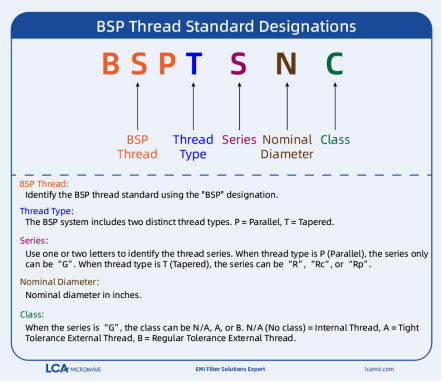
BSP P S N C
BSP Thread Thread Type Thread Series Nominal Diameter Thread Class
BSP Thread:
Identify the BSP thread standard using the “BSP” designation.
Thread Type:
The BSP system includes two distinct thread types. P = Parallel, T = Tapered.
Series:
Use one or two letters to identify the thread series. when thread type is P (Parallel), the series only can be “G”. When thread type is T(Tapered), the series can be “R”,“Rc” , or“Rp”.
Nominal Diameter:
Nominal diameter in inches.
Class:
when the series is “G” , the class can be N/A,A, or B.N/A(No class)= Internal Thread, A=Tight Tolerance External Thread,B = Regular Tolerance External Thread.
Common BSP thread designations include:
| Designation | Description |
| G 1/4 | BSP Parallel Thread |
| G 1/2 | BSP Parallel Thread |
| R 1/4 | BSP Tapered External Thread |
| Rc 1/4 | BSP Tapered Internal Thread |
| Rp 1/4 | BSP Parallel Internal Thread (for pressure-tight joints with R external threads) |
Each designation defines the thread form, sealing method, and intended application.
Advantages of BSP Threads
BSP threads offer several important advantages:
- Internationally recognized pipe thread standard.
- Excellent compatibility across global markets.
- Available in both parallel and tapered forms.
- Reliable sealing when used correctly.
- Broad availability of fittings and tooling.
- Suitable for hydraulic, pneumatic, and fluid systems.
These benefits have made BSP one of the most widely used pipe thread systems outside North America.
Limitations
Despite their widespread use, BSP threads have some limitations:
- Not interchangeable with NPT threads.
- Requires the correct sealing method depending on thread type.
- Different thread angle from Unified and NPT threads.
- Incorrect pairing of BSPP and BSPT components may result in leakage.
Always verify the thread designation and applicable standard before assembly.
Typical Applications
BSP threads are commonly found in:
- Hydraulic systems
- Pneumatic equipment
- Industrial automation
- Water treatment systems
- Process control instrumentation
- Pressure sensors
- Valves and manifolds
- Laboratory equipment
- Chemical processing equipment
- Industrial enclosures and connectors
How to Choose BSP Threads
Choose BSPP when:
- An O-ring or gasket provides the seal.
- The connection may require repeated assembly.
- Precise positioning of the fitting is important.
Choose BSPT when:
- The thread itself contributes to sealing.
- A tapered connection is specified by the equipment manufacturer.
- Pipework or fluid systems require pressure-tight threaded joints.
Always follow the equipment drawing or applicable standard to ensure compatibility.
BSP vs NPT
Although BSP and NPT are both widely used pipe thread systems, they differ in several key aspects.
| Feature | BSP | NPT |
| Thread Angle | 55° | 60° |
| Thread Profile | Whitworth | Unified |
| Thread Types | BSPP / BSPT | NPT / NPTF |
| Main Regions | Europe, Asia, Australia | North America |
| Interchangeability | No | No |
Because of differences in thread angle, profile, and dimensions, BSP and NPT threads should not be considered interchangeable, even when the nominal size appears similar.
Industry Standards
BSP threads are primarily defined by:
- ISO 7-1— Pipe threads where pressure-tight joints are made on the threads
- ISO 228-1— Pipe threads where pressure-tight joints are not made on the threads
- BS EN 10226— British Standard pipe thread specification
Engineers should always consult the latest applicable standards and product drawings when selecting BSP threaded components.
Frequently Asked Questions
- What does BSP stand for?
BSP stands for British Standard Pipe, a globally recognized pipe thread system used for fluid and gas connections.
- What is the difference between BSPP and BSPT?
BSPP uses parallel threads and typically seals with an O-ring or gasket, while BSPT uses tapered threads that help create the seal through thread interference.
- Are BSP and NPT compatible?
No. BSP and NPT differ in thread angle, profile, taper, and dimensions, so they should not be mixed.
- What does the letter “G” mean?
The letter G identifies a BSPP (parallel) thread in accordance with ISO 228.
- What does the letter “R” mean?
The letter R identifies an external BSPT (tapered) thread. Rc indicates an internal tapered thread, and Rp indicates a parallel internal thread used with tapered external threads in pressure-tight joints.
Engineering Support CTA: Selecting a threaded EMI filter or feedthrough capacitor? Share the thread standard and size, panel thickness, voltage/current, capacitance, and environmental requirements with LCA engineers. View Thread Mount Feedthrough Filters
Related Engineering Resources
Continue Exploring LCA Thread Engineering Center
British Standard Pipe (BSP) threads remain one of the most widely used pipe thread systems worldwide. Continue exploring the LCA Thread Engineering Center for detailed BSPP and BSPT guides, engineering comparison articles, thread charts, and application resources to help you specify compatible threaded components with confidence.