Introduction
Quick Answer: UNF (Unified National Fine) is the fine-pitch thread series within the Unified Thread Standard (UTS).
UNF (Unified National Fine) is the fine-pitch thread series within the Unified Thread Standard (UTS). Compared with UNC threads, UNF threads have more threads per inch (TPI), providing increased tensile strength, improved vibration resistance, and more precise adjustment.
Because of these characteristics, UNF threads are widely used in aerospace, automotive, hydraulic systems, instrumentation, telecommunications, and other applications where reliable fastening and precision are critical.
Quick Definition
UNF (Unified National Fine) is the fine-thread series defined by the Unified Thread Standard (UTS). By using a finer thread pitch than UNC, UNF threads offer greater clamping force, improved resistance to loosening, and better performance in precision mechanical assemblies.
What Are UNF Threads?
UNF threads are designed for applications requiring higher fastening performance than standard coarse threads.
A finer thread pitch means that more threads engage over the same length, increasing the contact area between mating threads. This results in improved load distribution, higher preload capability, and better resistance to vibration.
Common UNF thread sizes include:
- 10-32 UNF
- 1/4-28 UNF
- 5/16-24 UNF
- 3/8-24 UNF
- 7/16-20 UNF
- 1/2-20 UNF
These dimensions are standardized under ASME B1.1, ensuring interchangeability across manufacturers.
History & Development
UNF was introduced alongside UNC as part of the Unified Thread Standard to provide a standardized fine-thread alternative for engineering applications requiring higher precision.
While UNC became the preferred choice for general-purpose fastening, UNF was developed for situations where greater clamping force, better fatigue resistance, and finer adjustment were necessary.
Today, UNF remains one of the most widely specified thread series in transportation, aerospace, fluid power systems, and electronic equipment.
Key Characteristics
| Characteristic | Specification |
| Standard | ASME B1.1 |
| Measurement System | Inch |
| Thread Angle | 60° |
| Thread Pitch | Fine |
| Pitch Unit | Threads Per Inch (TPI) |
| Common Thread Classes | 2A, 2B, 3A, 3B |
| Primary Use | General-purpose fastening |
Understanding UNF Thread Designations
A standard UNF designation consists of four parts:
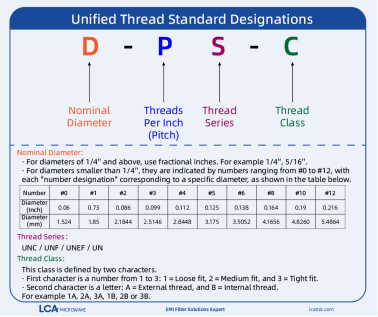
D – P S – C
Nominal Diameter – Threads Per Inch Thread Series – Thread Class
Nominal Diameter:
- For diameters of 1/4″ and above, use fractional inches. For example 1/4″, 5/16″.
- For diameters smaller than 1/4″, they are indicated by numbers ranging from #0 to #12, with each “number designation” corresponding to a specific diameter, as shown in the table below.
Diameter Number | #0 | #1 | #2 | #3 | #4 | #5 | #6 | #8 | #10 | #12 |
| Diameter (Inch) | 0.06 | 0.073 | 0.086 | 0.099 | 0.112 | 0.125 | 0.138 | 0.164 | 0.19 | 0.216 |
| Diameter (mm) | 1.524 | 1.8542 | 2.1844 | 2.5146 | 2.8448 | 3.175 | 3.5052 | 4.1656 | 4.8260 | 5.4864 |
Pitch:
The pitch is given in Threads Per Inch (TPI).
Thread Series:
UNF
Thread Class:
This class is defined by two characters. For example 1A, 2A, 3A, 1B, 2B or 3B.
- First character is a number from 1 to 3: 1 = Loose fit, 2 = Medium fit, and 3 = Tight fit.
- Second character is a letter: A = External thread, and B = Internal thread.
Example:
5/16-24 UNF-2A
| Element | Description |
| 5/16 | Nominal Diameter |
| 24 | Threads Per Inch |
| UNF | Unified National Fine |
| 2A | External Thread Class |
This naming convention enables engineers to identify the thread dimensions and tolerance requirements at a glance.
Advantages of UNF Threads
UNF threads provide several engineering advantages:
- Higher clamping force
- Better resistance to vibration
- Increased fatigue strength
- More accurate adjustment
- Greater thread engagement over the same length
- Excellent performance in high-load assemblies
These characteristics make UNF an excellent choice where fastening performance is more important than assembly speed.
Limitations
UNF threads may not be suitable when:
- Frequent assembly and disassembly are required.
- Components are exposed to dirt or debris.
- Softer materials are used extensively.
- Rapid assembly is the primary objective.
In these situations, UNC threads often provide better overall performance.
Typical Applications
UNF threads are widely used in:
- Aerospace systems
- Automotive assemblies
- Hydraulic equipment
- Pneumatic fittings
- Precision instruments
- Telecommunications hardware
- Medical equipment
- RF components
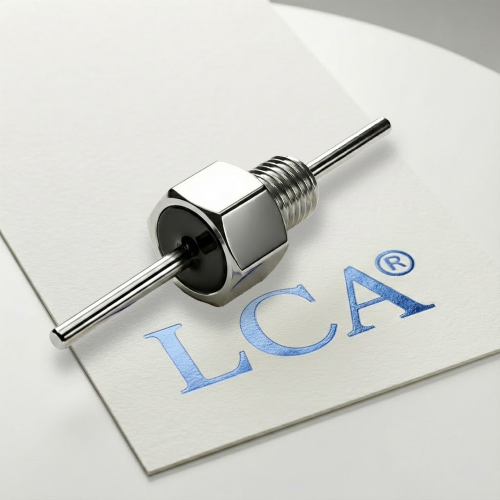
- Threaded feedthrough filters
- Military electronics
Because many feedthrough filters require secure mounting and reliable vibration resistance, UNF threads are commonly specified for demanding industrial environments.
How to Choose UNF Threads
Choose UNF threads when:
- High preload is required.
- Vibration resistance is important.
- Installation space is limited.
- Components experience cyclic loading.
- Precision alignment is required.
Consider other thread series when:
- Assembly speed is critical.
- Threads will be frequently removed.
- Materials are relatively soft.
- Dirt or contamination is expected.
UNC vs UNF
| Feature | UNC | UNF |
| Thread Pitch | Coarse | Fine |
| Threads Per Inch | Fewer | More |
| Assembly Speed | Faster | Slower |
| Clamping Force | Moderate | Moderate |
| Thread Strength | Better in soft materials | Higher preload |
| Vibration Resistance | Good | Better |
| Typical Applications | General machinery | Aerospace, automotive, precision equipment |
UNF vs ISO Metric Threads
| UNF | ISO Metric |
| Inch dimensions | Metric dimensions |
| Pitch defined by TPI | Pitch defined in millimeters |
| ASME B1.1 | ISO 68 / ISO 261 / ISO 965 |
| North American standard | International standard |
Although both use a 60° thread angle, they are not interchangeable.
Industry Standards
UNF threads are primarily defined by:
- ASME B1.1 — Unified Inch Screw Threads
- ASME B1.2 — Gages and Gauging
- ANSI B1 Series
- SAE J476 (industry reference for threaded fasteners)
Always refer to the latest applicable standard when specifying or inspecting UNF threads.
UNF Series Basic Dimensions chart
Click Thread Link to check more data for each thread.
| Thread | Threads per inch (TPI) | Basic Major Diameter | Basic Minor Diameter | Thread Height | |||
| (in) | (mm) | (in) | (mm) | (in) | (mm) | ||
| #0 – 80 UNF | 80 | 0.06 | 1.524 | 0.0451 | 1.146 | 0.0068 | 0.173 |
| #1 – 72 UNF | 72 | 0.073 | 1.854 | 0.0565 | 1.435 | 0.0075 | 0.191 |
| #2 – 64 UNF | 64 | 0.086 | 2.184 | 0.0674 | 1.712 | 0.0085 | 0.216 |
| #3 – 56 UNF | 56 | 0.099 | 2.515 | 0.0777 | 1.974 | 0.0097 | 0.246 |
| #4 – 48 UNF | 48 | 0.112 | 2.845 | 0.0872 | 2.215 | 0.0113 | 0.287 |
| #5 – 44 UNF | 44 | 0.125 | 3.175 | 0.0979 | 2.487 | 0.0123 | 0.312 |
| #6 – 40 UNF | 40 | 0.138 | 3.505 | 0.1082 | 2.748 | 0.0135 | 0.343 |
| #8 – 36 UNF | 36 | 0.164 | 4.166 | 0.1309 | 3.325 | 0.015 | 0.381 |
| #10 – 32 UNF | 32 | 0.19 | 4.826 | 0.1528 | 3.881 | 0.0169 | 0.429 |
| #12 – 28 UNF | 28 | 0.216 | 5.486 | 0.1735 | 4.407 | 0.0193 | 0.49 |
| 1/4 – 28 UNF | 28 | 0.25 | 6.35 | 0.2075 | 5.271 | 0.0193 | 0.49 |
| 5/16 – 24 UNF | 24 | 0.313 | 7.938 | 0.2629 | 6.678 | 0.0226 | 0.574 |
| 3/8 – 24 UNF | 24 | 0.375 | 9.525 | 0.3254 | 8.265 | 0.0226 | 0.574 |
| 7/16 – 20 UNF | 20 | 0.438 | 11.112 | 0.378 | 9.601 | 0.0271 | 0.688 |
| 1/2 – 20 UNF | 20 | 0.5 | 12.7 | 0.4405 | 11.189 | 0.0271 | 0.688 |
| 9/16 – 18 UNF | 18 | 0.563 | 14.288 | 0.4963 | 12.606 | 0.0301 | 0.765 |
| 5/8 – 18 UNF | 18 | 0.625 | 15.875 | 0.5588 | 14.194 | 0.0301 | 0.765 |
| 3/4 – 16 UNF | 16 | 0.75 | 19.05 | 0.6756 | 17.16 | 0.0338 | 0.859 |
| 7/8 – 14 UNF | 14 | 0.875 | 22.225 | 0.7899 | 20.063 | 0.0387 | 0.983 |
| 1 – 12 UNF | 12 | 1 | 25.4 | 0.9008 | 22.88 | 0.0451 | 1.146 |
| 1 1/8 – 12 UNF | 12 | 1.125 | 28.575 | 1.0258 | 26.055 | 0.0451 | 1.146 |
| 1 1/4 – 12 UNF | 12 | 1.25 | 31.75 | 1.1508 | 29.23 | 0.0451 | 1.146 |
| 1 3/8 – 12 UNF | 12 | 1.375 | 34.925 | 1.2758 | 32.405 | 0.0451 | 1.146 |
| 1 1/2 – 12 UNF | 12 | 1.5 | 38.1 | 1.4008 | 35.58 | 0.0451 | 1.146 |
Frequently Asked Questions
- What does UNF stand for?
Unified National Fine.
- Why choose UNF instead of UNC?
UNF provides greater clamping force, improved vibration resistance, and finer adjustment, making it suitable for precision applications.
- Are UNF threads stronger than UNC?
In many applications, UNF threads can achieve higher preload and better fatigue performance. However, the best choice depends on material, loading conditions, and design requirements.
- Can UNF threads mate with UNC threads?
No. Even if the nominal diameter is the same, the thread pitch differs, making them incompatible.
- Which UNF thread sizes are most common?
Popular sizes include 10-32 UNF, 1/4-28 UNF, 5/16-24 UNF, and 3/8-24 UNF.
Engineering Support CTA: Selecting a threaded EMI filter or feedthrough capacitor? Share the thread standard and size, panel thickness, voltage/current, capacitance, and environmental requirements with LCA engineers. View Thread Mount Feedthrough Filters
Related Engineering Resources
Related LCA Products
Continue Exploring LCA Thread Engineering Center
Whether you are selecting a standard fastener, designing a threaded EMI filter, or identifying a thread specification, understanding UNC threads is the first step toward choosing the correct fastening solution.
Browse our Thread Standards, Thread Charts, Thread Specifications, and Engineering Guides to access detailed engineering data, application recommendations, and dimensional references.