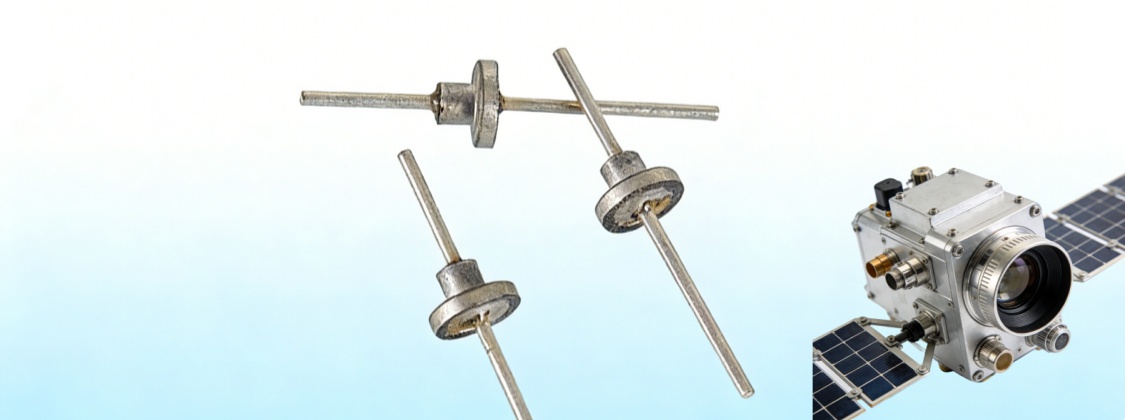
As a core device for space-based Earth observation and deep space exploration, satellite remote sensing cameras have imaging data accuracy that directly determines the success of missions such as topographic mapping, disaster monitoring, and resource exploration. These cameras need to capture weak optical signals and convert them into electrical signals. However, space is filled with strong radiation including cosmic rays and solar storms. Coupled with electromagnetic coupling interference between on-board equipment, these factors can easily cause signal distortion, image artifacts or data packet loss. With core advantages of low equivalent series inductance (ESL ≤ 0.1nH), high self-resonant frequency (SRF ≥ 5GHz) and extreme environment resistance, feedthrough capacitors have become the key adaptive components to ensure the stable operation of the cameras.
The power supply system is a critical entry point for interference. High-frequency clutter ranging from 100kHz to 1GHz, generated by the coupling of cosmic rays and on-board equipment, can easily invade the core circuits through the power supply link. Feedthrough capacitors are connected in series at the power input terminal of the camera, forming a high-efficiency filter network together with common-mode inductors. With an insertion loss ≥ 28dB, this network can accurately filter out broadband clutter, providing clean power with a ripple ≤ 3mV for CCD/CMOS imaging devices and image processing units. It eliminates imaging deviations caused by power supply noise from the source and ensures the signal conversion accuracy of photosensitive components.
In the signal transmission link, remote sensing data needs to be transmitted to on-board storage or ground receiving stations at high speed and stably. Signal reflection and electromagnetic crosstalk at the interface can seriously affect data integrity. The LCA® feedthrough capacitors deployed at the remote sensing data transmission interface can effectively suppress signal reflection, block electromagnetic crosstalk, and ensure distortion-free transmission of image data. Meanwhile, the product adopts a ceramic sealing process, which can withstand extreme high and low temperatures ranging from -55℃ to 125℃, vacuum and strong radiation environments. Combined with the 360° surface contact grounding design of the shielding cavity (grounding impedance ≤ 100mΩ), it further enhances anti-interference capability. It comprehensively ensures that satellite remote sensing cameras continuously acquire high-quality and high-precision imaging data in complex space environments, building a solid technical defense line for various space observation missions.