Industrial automation environments present some of the most demanding conditions for electromagnetic compatibility (EMC) management. High-power switching devices, motors, and inverters generate substantial conducted interference that can propagate along power and signal lines, disrupting nearby control electronics. Threaded mount feedthrough capacitors are one of the primary tools engineers use to address this problem at panel and cabinet entry points.
Based on LCA’s experience supporting industrial automation and other EMC-critical applications, proper feedthrough capacitor selection and installation play an important role in achieving reliable EMI suppression and long-term system performance.
This article covers where threaded mount feedthrough capacitors are typically applied in automation systems, why this mounting style is suited to industrial environments, and what engineers need to evaluate during selection and procurement.
Why Industrial Automation Equipment Generates Conducted EMI
The Dominant Noise Sources: VFDs, Servo Drives, and IGBT Controllers
Variable frequency drives (VFDs), servo amplifiers, and other IGBT-based power converters are the primary sources of conducted electromagnetic interference in automation systems. These devices switch at frequencies typically ranging from 2 kHz to 20 kHz, and each switching transition generates harmonic content that propagates along connected power and signal cables.
The interference does not stay within the drive itself. It couples into the plant power distribution network and travels along cable runs to reach PLCs, sensors, communication interfaces, and other control electronics — often causing false triggering, data errors, or reduced sensor accuracy.
Common Mode vs. Differential Mode Interference
Conducted EMI in automation systems appears in two forms. Common mode noise rides on bothconductors simultaneously relative to chassis ground and is the dominant issue in most drive and inverter installations. Differential mode noise appears between the active conductors and is more relevant at lower frequencies and in certain power supply topologies.
Understanding which mode dominates in a given application is a prerequisite for selecting the correct filter topology. A filter optimized for common mode suppression will not adequately address differential mode noise, and vice versa.
Why Are Threaded Feedthrough Capacitors Suitable for Industrial Environments?
- Industrial control cabinets and machine enclosures require EMI filters that can withstand factory conditions: vibration, temperature cycling, periodic maintenance access, and high-current wiring. Threadedterminal connections are preferred for field wiring because they are reliable under vibration, compatible with standard industrial cable terminations, and accessible for inspection and service without soldering.
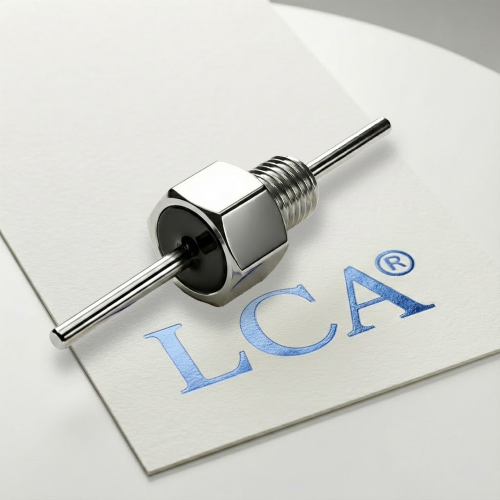
- For threaded mount feedthrough capacitors, the threaded body creates a direct metal-to-metal bond with the chassis wall, which maintains enclosure shielding continuity at conductor entry points. This is more effective for high-frequency noise suppression than PCB-mount filters, which rely on board-level ground planes with longer and less controlled noise return paths.
Key Application Areas in Industrial Automation
PLC Control Cabinets and I/O Signal Lines
- PLC cabinets often aggregate hundreds of signal connections — digital I/O, analog sensor inputs, and fieldbus interfaces — in close proximity to power wiring. Conducted noise entering through unfiltered cable entries can cause I/O read errors, spurious outputs, or communication faults. threaded mount feedthrough capacitors are commonly placed at the cabinet wall where these signal lines enter. For low-level signal lines, filter capacitance must be carefully constrained to avoid degrading signal bandwidth. Oversized capacitance can round signal edges on digital lines or introduce phase error on analog inputs.
Variable Frequency Drives (VFD) and Servo Amplifiers
- VFD input and output lines are among the highest-priority locations for EMI filtering in automation installations. Input-side filters reduce conducted noise injected back into the plant power network. Output-side filtering is more application-specific and requires careful consideration of the drive’s output frequency range and any cable length limitations.
- Servo drive applications have an additional concern: feedback integrity. Noise on encoder lines or resolver cables can introduce velocity and position errors. Threaded mount feedthroughfilters on signal cables entering servo amplifier enclosures help isolate feedback paths from the high-frequency switching noise generated by the drive’s own power stage.
CNC Machine Tool Control Enclosures
- CNC environments combine spindle motors, servo axes, and high-frequency switching regulators in a physically compact arrangement. Multiple noise sources operate simultaneously and independently, making conducted EMI management complex. Threaded mount filters are widely used at the machine’s main power entry and at the individual axis drive inputs.
Industrial Robotics and Motion Control Systems
- Robotic systems present similar challenges to CNC equipment, with the additional consideration that cable bundles flex with arm motion. Threadedmount filters on the robot controller enclosure handle the stationary portion of the EMI management strategy, while cable shielding and grounding address the flexible cable runs.
Installation Considerations for Industrial Environments
Correct installation is necessary for a threaded mount feedthrough capacitorto deliver its rated attenuation.
The following points apply to both threaded mount and feedthrough-style products, though specific parameters must always be taken from the product’s datasheet or installation guide.
Torque and chassis contact:
For threaded mount filters, apply the torque value specified in the manufacturer’s installation documentation. Under-torqued mounting reduces the quality of the chassis ground bond, which increases ground path impedance and reduces high-frequency attenuation.
Cable routing:
Keep cables on the filtered (clean) side of the filter physically separated from cables on the unfiltered (noisy) side. If these cables run parallel or share a bundle, noise on the unfiltered side can re-couple onto the filtered conductors, bypassing the filter entirely. This is one of the most common causes of unexpectedly poor EMI performance after installation.
Panel surface preparation:
Mounting surfaces should be free of paint, anodizing, or oxidation in the contact area to ensure a low-impedance electrical bond to the chassis.
Conclusion
Threaded mount feedthrough capacitors are widely used in industrial automation systems. They remain one of the most effective solutions for controlling conducted EMI at enclosure entry points. From PLC control cabinets and VFD installations to CNC machines and industrial robotics, they help maintain EMC performance by providing a low-impedance path for high-frequency noise to return to chassis ground.
Based on LCA’s experience supporting industrial automation and other EMC-critical applications, successful EMI suppression depends on selecting the appropriate filter specifications. Equally important are proper installation, grounding quality, and cable routing practices. When these factors are considered together, threaded mount feedthrough capacitors significantly improve system reliability and reduce EMC-related issues. This also simplifies compliance testing throughout equipment development and deployment.
Frequently Asked Questions
Q: Why are threaded mount feedthrough capacitors preferred over PCB-mount filters in automation control cabinets?
Threaded mount feedthrough capacitors mount at the panel wall, creating a low-impedance ground bond at the enclosure entry point and preserving chassis shielding continuity. PCB-mount filters rely on board-level ground planes, which introduce a longer and less controlled noise return path in panel-entry applications. The shorter ground path of a chassis-mounted filter is generally more effective at high frequencies.
Q: Is “screw type” the same as “feedthrough” in EMI filter terminology?
Not necessarily. Some products described as screw type use screw terminals for field wiring while using a conventional panel-mount body. Others use a threaded feedthrough construction. In this design, the conductor passes through the filter body, which is then screwed into the panel wall.
Q: Can the same filter be used on both the VFD power input and the PLC signal cabinet?
Generally not. VFD power entries typically require high-current three-phase filters rated for the drive’s input supply. PLC and signal cabinets require lower-current filters with capacitance values appropriate for the signal frequencies involved. Using a power-rated filter on a signal line can impair signal integrity.
Q: Does a higher current rating mean better EMI attenuation?
No. Current rating and attenuation are independent parameters. A filter must meet both the electrical load requirements and the noise suppression requirements. These must be specified separately.
Q: How does leakage current affect filter selection in automation installations?
EMI filter capacitors connected to chassis ground produce a leakage current under normal operating conditions. In installations protected by residual current devices (RCDs), this leakage current contributes to the total protective earth current. As a result, it can trip the RCD even under normal operating voltages. Verify the filter’s specified leakage current against the RCD trip threshold and any applicable plant or safety requirements.
Q: Are threaded mount feedthrough capacitors suitable for outdoor or wash-down factory environments?
Some product families include sealed or coated variants with appropriate IP ratings for harsh environments. Suitability depends on the specific product’s IP rating, operating temperature range, and vibration specification.
Need Help Selecting Threaded Mount Feedthrough Capacitors for Industrial Automation?
Every industrial application is different — and so is every EMI challenge.
LCA’s engineering team can analyze your needs for PLC cabinets, VFDs, CNC machines, industrial robotics, and other applications. They will then recommend the most suitable threaded mount feedthrough capacitor or EMI filter solution.
Contact LCA today for one-to-one technical support and customized EMI suppression recommendations.