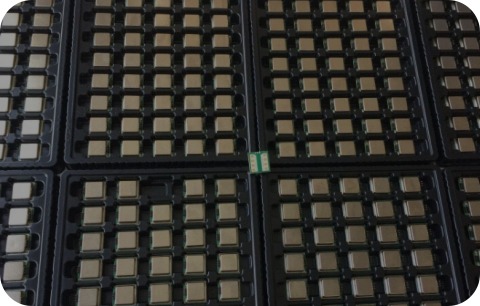
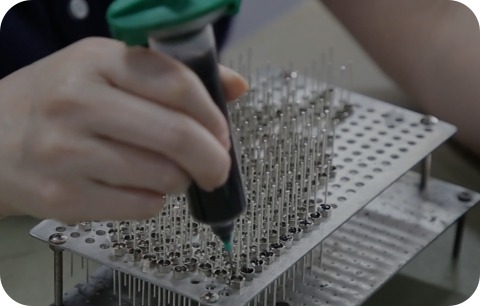
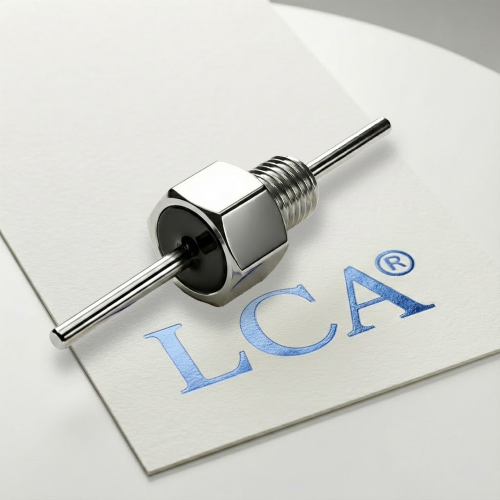
In the packaging process of LCA® EMI feedthrough capacitors, epoxy potting and glass-to-metal sealing are two core sealing and insulation solutions. They directly determine the capacitor’s protection level, temperature stability, high-frequency performance, and application scenarios.
1.Core Definitions: The Essence of the Two Sealing Processes
1.)Epoxy Potting
-Technical Principle: Uses epoxy resin as the packaging material. Through potting and curing processes, it fixes and seals the feedthrough capacitor’s central conductor, dielectric layer, and metal shielding case, forming an insulation and protection barrier.
-Core Functions:
①Mechanical fixation (prevents component loosening);
②Environmental sealing (dustproof, moistureproof, and resistant to mild corrosion);
③ Electrical insulation (isolates the conductor from the shielding case).
2).Glass-to-Metal Sealing
-Technical Principle: Adopts high-temperature-resistant glass as the insulation and sealing medium. The glass is melted at high temperatures to form an atomic-level bond between the central conductor (typically Kovar alloy), glass, and metal shielding case, achieving reliable sealing and insulation.
-Core Functions:
①High-hermeticity sealing;
②Extreme environment protection (resistant to high temperatures, strong corrosion, and radiation);
③Long-term stable insulation (no aging or shrinkage).
2.Core Impacts on EMI Feedthrough Capacitor Performance
1).Epoxy Potting: Cost-Effective Choice for Conventional Scenarios
Advantageous Impacts:
-Low cost and high mass production efficiency;
-Excellent toughness, adaptable to the vibration environments of automotive and industrial equipment;
-Insulation performance meets the requirements of low-to-medium frequency scenarios, with no significant impact on suppressing general conducted and radiated noise.
Limiting Impacts:
-Restricted high-frequency performance: Dielectric loss of epoxy resin makes it incompatible with high-frequency scenarios such as 5G millimeter-wave and satellite communications above 10GHz;
-Weak environmental adaptability: Long-term exposure to high temperatures, high humidity, or corrosive environments can cause epoxy aging and cracking, leading to seal failure. Moisture intrusion may result in dielectric breakdown and capacitor short circuits;
-Relatively short service life: Conventional epoxy-potted capacitors have a service life of approximately 5–10 years.
2).Glass-to-Metal Sealing: Indispensable for High-End Scenarios with Ultimate Stability and Reliability
Advantageous Impacts:
-Outstanding high-frequency performance: Low dielectric loss of glass ensures stable Self-Resonant Frequency (SRF) and low insertion loss for capacitors even above 60GHz, making it the core choice for high-frequency scenarios such as 5G millimeter-wave, radar, and satellite communications;
-Extreme environment resistance: Capable of long-term operation in a wide temperature range of -65℃ to +400℃;
-Ultra-long service life: Up to 20–30 years, meeting the long-life requirements of aerospace, military, and medical equipment.
Limiting Impacts:
-High cost: 3–10 times the price of epoxy-potted capacitors;
-Weak impact resistance: Glass is brittle, and severe equipment impact may cause cracks in the glass sealing layer, requiring additional metal shielding case protection.
The core difference between epoxy potting and glass-to-metal sealing lies in the trade-off between “cost-effectiveness” and “ultimate reliability”:
-Epoxy potting covers civilian and conventional industrial scenarios with its low-cost and high-volume advantages;
-Glass-to-metal sealing dominates core fields such as aerospace, military, and high-end communications due to its superior high-frequency performance and extreme environment resistance.
Selection should be based on comprehensive judgment of the equipment’s operating frequency, environmental conditions, service life requirements, and cost budget—this is also the key process support for LCA® EMI feedthrough capacitors to achieve “full-scenario adaptability.”
——2024.3.22