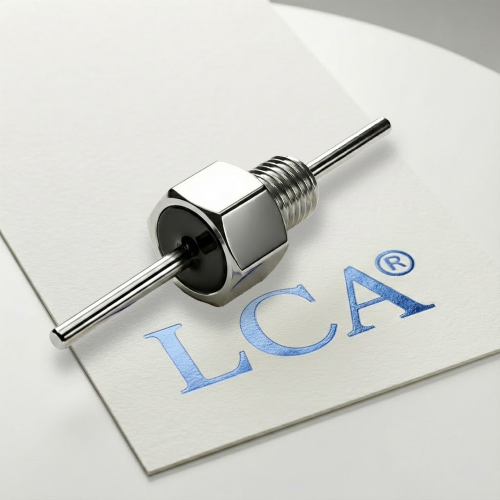
In the application of feedthrough capacitors, details determine success or failure. Many design failures stem not from the quality of the capacitor itself, but from overlooking critical design details. Below are three of the most common and costly design pitfalls, along with professional solutions provided by LCA.
Pitfall 1: Neglecting Grounding Quality——The “Lifeline” of the Filter
Root Cause: The superior performance of feedthrough capacitors relies on a low-impedance ground connection. A high-impedance grounding path can create a “noise loop,” which not only drastically reduces filtering effectiveness but may even become a new source of radiation. Many engineers spend significant time debugging filter circuits, only to find the issue lies in the seemingly simple grounding connection.
Solution:
-Shortest Path Principle: Connect the capacitor’s metal housing to the ground point using a conductor that is as short and thick as possible.
-Ground Point Selection: Prioritize using the chassis ground or a dedicated ground plane. Avoid using digital logic ground as the sink for high-frequency noise.
-Contact Surface Treatment: Ensure the mounting surface is clean and flat. Use conductive gaskets if necessary to eliminate contact impedance.
Pitfall 2: Misusing High Capacitance Values on Data Lines – The “Silent Killer” of Signal Integrity
Root Cause: On high-speed data lines, signal edges are very steep, containing rich high-frequency components. Using an excessively high capacitance value (e.g., >100pF) creates a low-pass filter that severely attenuates these high-frequency signals, leading to collapsed eye diagrams and skyrocketing bit error rates.
Solution:
-Precise Selection: Specifically choose low capacitance models for data lines (recommended range: 10pF to 100pF) to strike a balance between filtering needs and signal quality.
Pitfall 3: Incorrect Installation Location——Rendering Shielding Effectiveness Useless
Root Cause: Installing the filter inside the shielding enclosure is like setting up a checkpoint inside the castle after the enemy has already entered the gates. Noise couples with the signal lines within the enclosure, making filtering at this point too late.
Solution:
-“Guard at the Border” Principle: Always install the feedthrough capacitor directly on the electromagnetic boundary of the shielding enclosure itself.
-Correct Layout: Ensure all conductors entering or exiting the shielded enclosure must pass through it. This guarantees noise is diverted to ground before it can enter the sensitive circuit area.
Avoiding these pitfalls is not inherently difficult; the key lies in a deep understanding of how feedthrough capacitors work and strict control over design details. LCA not only provides high-performance feedthrough capacitor products but is also committed to being your successful design partner. We offer comprehensive support from selection and layout to debugging, helping you succeed the first time.
——2023.5.13