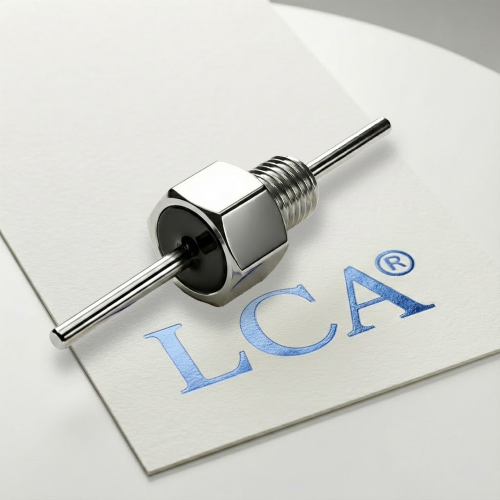
Ceramic capacitors are the heart of the filter and can be damaged by thermal and mechanical shock, as well as by overvoltage. Care should be taken to minimize the risk of stress when mounting the flter to the panel and soldering the wires to the filter terminals.
Install on the panel(Installation torque): The recommended mounting rotation relative to the housing should be used when mounting the filter to a bulkhead or panel. This is an important point. Otherwise, the ceramic capacitor inside may be damaged due to deformation of the casing.
Tool: Hexagonal filters should be installed with suitable bushings or wrenches. The round head filter can be installed on the panel in one of the following two ways (cannot be installed with pliers tools to avoid damaging the filter):
1.Round body with grooved top designed for easy turning with special tools enter.
2.A round body without a slotted top is used to insert into the slotted hole and use Nut fixation. The flat surface processing of the thread and the flat surface engagement in the hole combine.
Ground: In order to ensure the normal operation of the filter, the filter housing must be sufficiently connected to the ground of the panel to provide an effective path for interference. Adhesive locking is not recommended and, if used, should be done after the filter is installed.
Minimum plate thickness: Users should note that sometimes feedthrough filters have undercuts between the threads and the mounting edge of the housing. When the thickness of the installed plate is less than the length of the undercut, problems will arise in the tight fit of the threaded holes and the positioning of the filter. Therefore, whenever possible thickness of the panel should be greater than the length of the undercut.
Maximum plate thickness: This indicator is used to ensure that the nut can be fully locked including the use of washers.
Terminal soldering
Soldering temperature: The temperature of the soldering iron tip should not exceed 300℃.
Soldering time: The dwell time should be 3-5 seconds maximum to minimize the risk of cracking the capacitor due to thermal shock.
Soldering materials: Soldering materials can be SN60, SN62 or similar types.
Heat sink: Use a radiator between the soldering point and the case as much as possible, especially when the soldering time is long. Excessive soldering time and failure to dissipate heat in time will cause secondary melting of the internal soldering part of the capacitor.
Lead bending and trimming: The bending of the flter lead should not be done within 4mm of the epoxy seal, and the lead should be supported when trimming it.
——2022.4.18