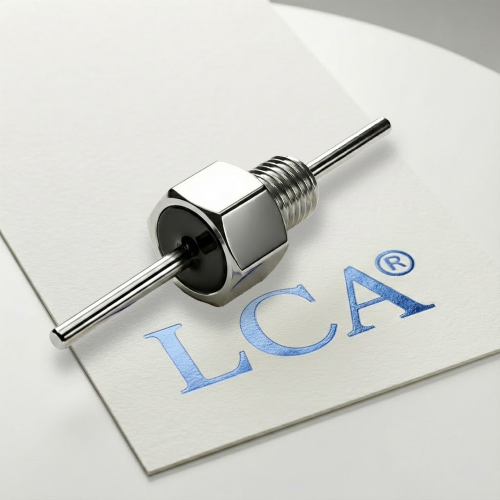
In the process of electronic equipment combating electromagnetic interference (EMI), the performance of filtering directly determines equipment stability. With its unique structural design, the LCA® feedthrough capacitor demonstrates irreplaceable advantages in the field of filtering, particularly suited for high-frequency and complex electromagnetic environments.
Its core advantage first lies in its high-frequency low-impedance characteristics. Conventional capacitors are limited by their lead design, which introduces significant lead inductance. When the frequency rises to several hundred MHz or higher, the resonance caused by lead inductance leads to drastic fluctuations in capacitor impedance, resulting in a significant decline in filtering capability. In contrast, the feedthrough capacitor adopts a “current passing through the body” structure, minimizing the current path and reducing the equivalent series inductance (ESL) to 1/10 or even less of that of traditional capacitors. In high-frequency scenarios such as 5G base station RF modules and satellite communication equipment, feedthrough capacitors maintain stable low impedance in the GHz frequency range, efficiently directing high-frequency noise to the ground terminal, preventing noise from interfering with signal transmission, and ensuring communication quality.
Secondly, feedthrough capacitors possess a strong ability to block high-frequency coupling. Inside electronic equipment, dense wiring can lead to parasitic capacitance between conductors, causing cross-coupling of high-frequency signals and resulting in interference “leakage.” The metal casing of the feedthrough capacitor is directly grounded, physically isolating the input and output terminals, acting as a “barrier” in the path of interference propagation. For example, in industrial frequency converters, high-frequency interference generated by power modules can easily couple into the control circuit through wiring. After installing feedthrough capacitors, the interference coupling path is blocked, preventing control signal distortion and ensuring precise adjustment of motor speed by the frequency converter.
Furthermore, its wide-frequency stable filtering performance makes it suitable for complex electromagnetic environments. Through a multi-layer ceramic dielectric stacking design, feedthrough capacitors can cover a filtering range from tens of kHz low frequency to several GHz high frequency, eliminating the need for multiple types of capacitors to address multi-band interference. In the automotive electronics field, where low-frequency interference from engine ignition and high-frequency noise from onboard radar coexist, feedthrough capacitors can simultaneously suppress interference across different frequency bands, providing a clean power and signal environment for onboard chips and sensors, avoiding driving data errors or functional failures caused by interference.
At the same time, the environmental adaptability of feedthrough capacitors enhances the continuity of filtering. With a sealed metal casing and high-temperature-resistant ceramic dielectric, they can operate stably within a temperature range of -55°C to 125°C, under conditions of high vibration and humidity, with minimal fluctuation in capacitance and withstand voltage values. In aerospace equipment, despite extreme temperature, humidity, and vibration impacts, LCA® feedthrough capacitors can maintain stable filtering performance, ensuring that navigation and measurement-control systems are unaffected by electromagnetic interference, thereby safeguarding the reliable operation of the equipment.
——2021.12.14