The core mission of an EMI feedthrough capacitor is to “suppress high-frequency electromagnetic interference,” and its Self-Resonant Frequency (SRF) directly defines its “high-frequency operational range.” This is critical in the following aspects:
1.Scenario Selection & Compatibility: Different devices emit EMI noise at different frequencies. It is essential to select a feedthrough capacitor whose SRF is higher than the target noise frequency. Failure to do so means the capacitor cannot filter effectively and may even amplify interference (beyond the SRF, the capacitor behaves like an “inductor,” impeding high-frequency signals).
2.Embodiment of Technical Superiority: A key competitive advantage of feedthrough capacitors is their ability to overcome the SRF limitations of ordinary capacitors. This is achieved through their “lead-less coaxial structure,” which minimizes parasitic inductance. Ordinary leaded capacitors typically have SRF values in the range of tens to hundreds of MHz. High-frequency feedthrough capacitors can achieve SRF values exceeding 1 GHz (suitable for 5G and millimeter-wave applications). This high SRF capability was a key factor in their transition from being aerospace-specific components to becoming essential parts in commercial high-frequency devices.
3.Structural Design: The Innate Advantage
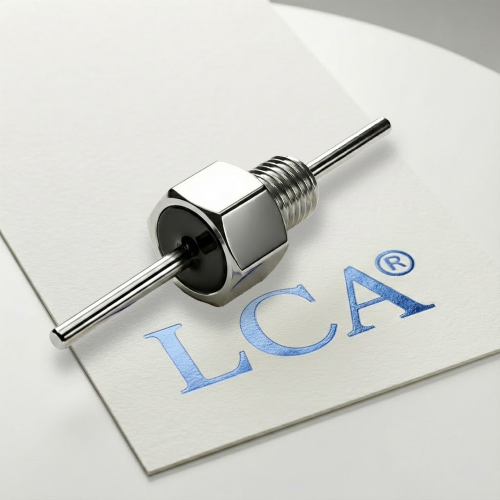
The leads of ordinary capacitors are a primary source of parasitic inductance; longer leads mean greater inductance and a lower SRF. The feedthrough capacitor’s coaxial structure, where the center conductor passes directly through the housing, virtually eliminates lead-based parasitic inductance. Furthermore, the magnetic fields generated by the metal housing and the center conductor cancel each other out, further reducing parasitic parameters. This is the fundamental reason why its SRF far surpasses that of ordinary capacitors.
4.Capacitance Value: A Trade-off with SRF
A capacitor’s self-resonant frequency is inversely proportional to its capacitance value. For capacitors of the same structure:
A smaller capacitance value results in a higher SRF.
A larger capacitance value results in a lower SRF.